

![[] HUMANITY'S LONGING FOR NOX](../article/2-humanity_obssetion_with_Nox.png.html)
- The Nox Race
The emergence of rockets, a new technology, quickly sparked a technological race among nations, much like car racing, cruise ship blue ribbon honors(Award given to ship for crossing the Atlantic Ocean) and transoceanic long-range flight competitions. The ensuing World War spurred further development of rocket technology, with various parties focusing on its development as a strategic offensive weapon for attacking deep into enemy territory. However, under the technological conditions of the time, the destructive power of rockets/missiles was far inferior to that of already mature military aircraft. Most rocket weapons deployed in combat during the World Wars caused only limited damage, except for the last one carrying a nuclear warhead.
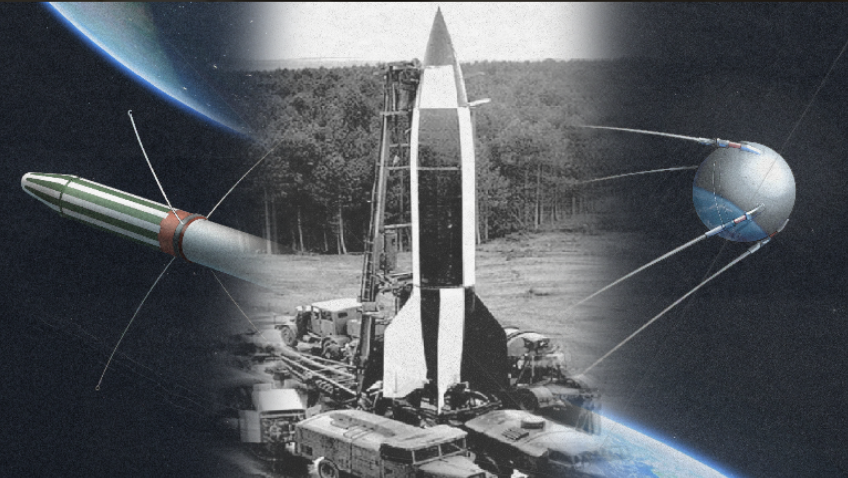
In 1950, the brutal World War had just ended. One of the two victorious supranational blocs, the Entente, immediately began its efforts to contain and subvert its wartime ally, the Phalanstery Union. The two blocs thus engaged in almost every form of confrontation worldwide, except for open warfare. It was also in this year that the Phalanstery Union used a rocket, an improved version of a long-range missile, to launch humanity's first artificial satellite into space. This not only marked the arrival of the space age but also provided the Union with a new arena to counter the containment of the Covenant: to forge a cosmic path to Nox in the name of all humanity.
The two factions subsequently poured vast resources into the space race, though the Union claimed the majority of the credits. The Union completed the first manned spaceflight, the first spacewalk, built the first space station, and, most importantly, achieved the first successful landing on Nox.