

![[] HUMANITY'S LONGING FOR NOX](../article/2-humanity_obssetion_with_Nox.png.html)
- Nox and Earth
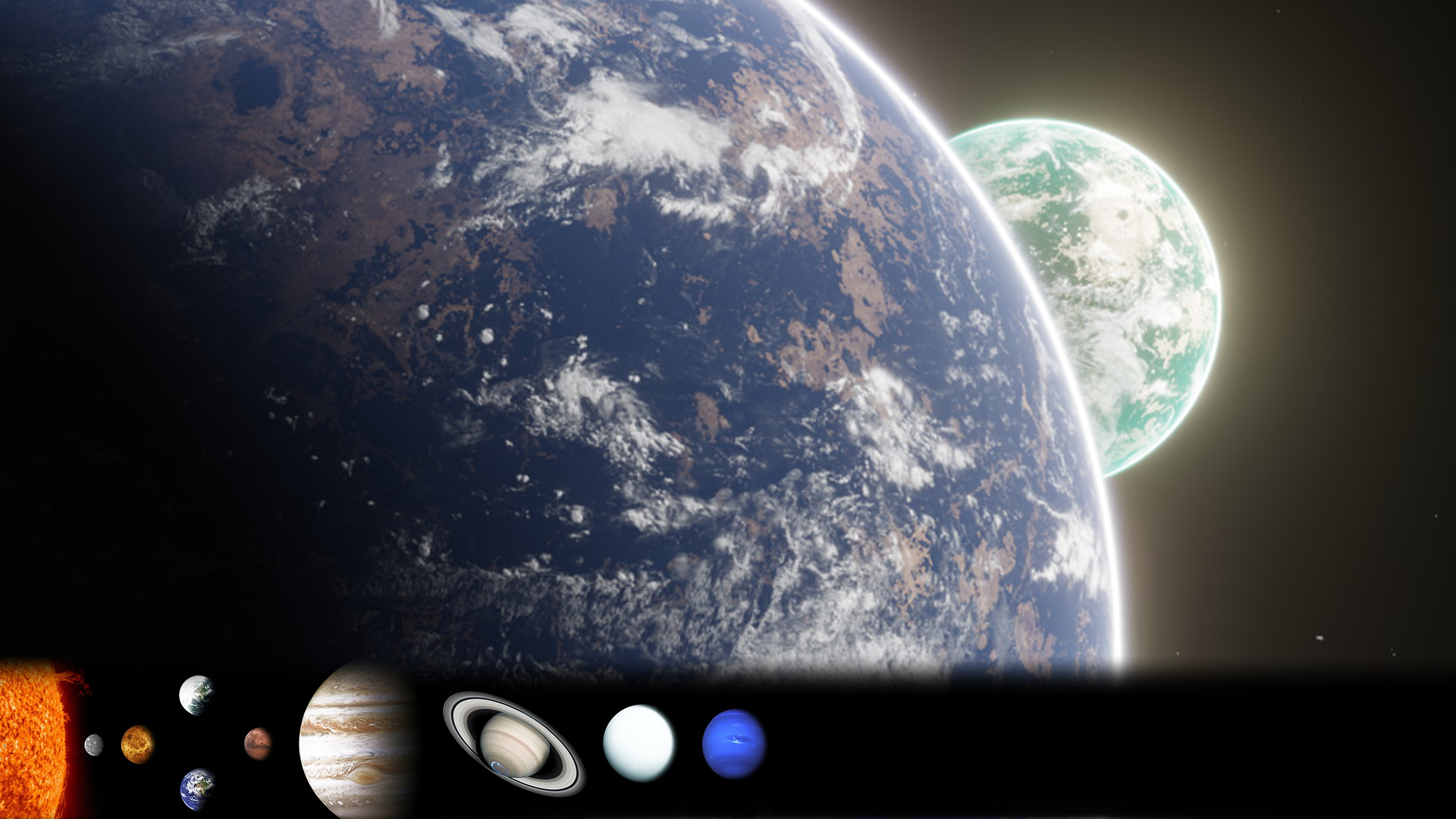
Nox (or, more commonly, called the Moon) is a terrestrial planet slightly smaller than Earth, with a mass approximately 0.94 times that of Earth. The center of mass of the two planets orbits each other in space .
The Earth-Nox binary system has an orbital period of 27.32 Earth days, while Nox's rotation period is 24 hours, 28 minutes and 15 seconds, slightly slower than Earth's. This leads to inhabitants on Nox generally using a binary calendar, and then subtracting one day at the end of a specific month to ensure that their dates are roughly aligned with Earth's.
In pre-modern cultures, Nox held a very important place. Poetry and legends depicting Nox has the celestial palaces, where immortals and mythical creatures lived. Since the invention of the telescope, scientific research on Nox has become a prominent field. Now, it is the most well-understood celestial body outside of Earth itself.
Astronomers already know that in the distant past, both Earth and Nox had rotation periods of only a few hours. Given time, Earth and Nox will become completely tidally locked. The rotation of both planets will slow down, their magnetic fields will weaken, their atmospheres may be stripped away and the probability of collisions with asteroids and other celestial bodies will greatly increase. Classical theory suggests that Earth and Nox will gradually move away until they separate, but the latest observational data shows that the distance between Earth and Nox is actually constantly decreasing, and the two planets may collide one day in the future.
Whether it's tidal locking or a collision, these catastrophes are not expected to occur for hundreds of millions of years, or at least millions of years. In the era of the space race, it was generally believed that future human civilization would certainly find a way to protect Earth and Nox. Now, most people estimate that human civilization will perish before the catastrophe even occurs.