


Related pages : [Main page] [Encyclopedia]
OUTLOOK ON FOREIGN MILITARY
ZVO       OUTLOOK ON FOREIGN MILITARY
foreign military review

The turning point for the multinational forces (TL note : Other name for the Entent):
New technologies, new frontiers, new philosophies, and the next enemy.

WHEELED TANK M1128 MGS

The turning point for multinational forces:
New technologies, new frontiers, new philosophies, and the next enemy.

Lieutenant Colonel Hayden R. Hoffman, 4th Infantry Division, Vespuccian Army

UVNI 1999 Defense Essay Contest, December 7, 1999

extract from the Journal of the Joint Armed Forces Academy of the Vladimir Federal Armed Forces
《Overseas Military Review(зарубежное военное обозрение)》
The magazine was published in January 2000.

Executive summary:
We are witnessing the end of an era: the space race and the Union of Phalanstery are over, along with tripwire strategies and nuclear kill zones. The political leadership holds an unwavering belief in Vespuccia's dominance in the 21st century (and beyond), a belief that may be challenged in the first decade, the first 25 years, and beyond: non-state actors may acquire former Union nuclear weapons through underground networks with rogue states; the Vladimir Federation may annex Ingmanlandia(Tl note: Historical region located in northwestern Russia, stretching along the southeastern shores of the Gulf of Finland.) under the command of a military dictator, posing a weaker but more uncertain threat to Europe.
The changing environment following the Cold War necessitates a re-examination of the way the United Vespuccian States military and its allies conduct future military operations. This article aims to offer some possible and practical policy recommendations for multinational forces to maintain their unparalleled military superiority in the 21st century, particularly before and after 2025, through a series of hypothetical scenarios and historical examples.
Turning Point 1 – The Globalized Contractual System vs. Global Threats: How to Understand This?

As you read this article, Vespuccia is facing an international environment unlike anything seen since World War II. The eastward expansion of the entente system is accelerating, encompassing former Union satellite states, and a global entente system is taking shape. At the same time, however, a variety of non-traditional security threats are emerging globally, including non-state actors and several notorious rogue regimes.

The two terrorist attacks in East Africa a year ago foreshadowed an era where global security was threatened by global threats—though they did not inflict fatal damage on the "Peace under Vespuccia." The Entent response to these attacks was a precise and effective air strike, completely avoiding ground intervention. In several other localized conflicts, precision-guided weapons have also inflicted devastating damage on regular ground forces and terrorist training camps.

We can confidently assert that there are currently no political constraints on the use of force by the Entente on Earth, just as it is difficult to imagine that such intervention during the Cold War would not have led to a full-scale nuclear war.

(Militaty Convoy image)
Army of the Republic of North Belka(Tl note: Can you see any borders from here? What have borders given us? The words of a dead man hold no meaning.) withdraws from Kosovo, June 20, 1999. (Getty Images)

The fact is this: the Gulf War became the last large-scale war, maintaining the traditional multinational force size and the prospect of tens of thousands of various nuclear warheads, whether for the Vespuccian Armed Forces or other allied forces under the Supreme Allied Command Europe, became both a waste of public funds and ineffective. One question lingered in the minds of all soldiers: why have we been winning? Countless wrecks of Union weapons and equipment burned on battlefields around the world, leading many to believe that the Phalanstery was a complete shell, a sensationalist advertisement concocted by arms dealers. This view is not entirely wrong; after all, we now clearly understand that the Union suffers from serious deficiencies in both its military equipment and its military structure.

PHALANSTERY BIG-7

The "seven key pieces" constituted the mainstay of the Unions forces and satellite states' armies, the multinational forces had conducted thorough training and preparations using them as hypothetical enemies for many years. However, in recent conflicts, these pieces of equipment were destroyed without proving effective.

However, the collapse of the Union unleashed the potential for excessive actions by various lower-level international actors, while the dispersal of military resources provided these actors with ample resources to create contentious international political activities. In the words of Lieutenant General David J. McDonald, the multinational force's enemy shifted from Union forces to a large contingent of smaller, weaker, less trained, but still lethal "Union-like" armies, so many new hotspots that even troop reductions became a point of contention. While the free world will ultimately be able to overwhelm these adversaries through sheer force, this "retail" global threat requires multinational force members to invest resources in new areas so that the entente can accurately address each (and even multiple simultaneously) non-global threat.

Turning Point 2—Technological Change and Theoretical Change: Twins or an Irreconcilable Contradiction?

(Major Bella Epstein headshot)
The new environment necessitates a new process of change. A theory that could have a global impact on the development of multinational forces is the "Spillover-based Operation (S-BO)" theory proposed by a group of Air Force theorists led by Major Bella Epstein—ironically dubbed the "PPT Mafia" by their colleagues. This ambitious theory attempts to break down the barriers between military branches, providing a unified theoretical roadmap for the transformation of ground, sea, air, and even space forces, and clearly outlining the demands for technological development

Contrary to the usual recommendations of improving training and upgrading equipment, Major Bella's theory argues that the focus should be on the fundamental objectives of operations, centering on the effects of the action. It views "failure" as a psychological and global "effect," and uses the desired outcome to guide the development of operational plans. Major Bella advocates moving beyond the constraints of the traditional "five-ring theory," prioritizing air power and long-range precision-guided weapons to strike the most potentially devastating links within the five rings. This includes targeting key connecting points between rings, and leveraging the widespread media coverage to instill a sense of defeat in the enemy leadership, ultimately undermining their resistance.

(Diagram image)
A diagram of Colonel John A. Warden III's Five Rings Theory. The enemy's organic components, from the core outwards, consist of the leadership, organic/systemic elements/key production facilities (such as nuclear facilities), infrastructure, population, and deployed troops. Colonel Warden advocated attacking each ring to paralyze the enemy's operational capabilities; this objective is also known as physical paralysis. To optimize the attack, the attacker will target as many rings as possible, with particular emphasis on destroying the central ring, i.e., the enemy's leadership. This will result in the complete paralysis of the enemy's entire system.

Recent conflicts have largely validated Major Bella's theory: multinational forces have struck terrorists with fewer than 20 Tomahawk missiles and brought about regime change in rogue states without any ground operations.

However, in Major Bella's theory, troops have transformed from users of firepower into mere appendages of it. Even after downsizing and technological innovation, massive ground forces and strategic nuclear forces remain a burden. All means conducive to non-contact strikes must be prioritized for development; for example, the idea of ​​using intercontinental ballistic missiles carrying nuclear warheads for global precision strikes is an exploration undertaken by the Air Force under the guidance of this theory. Major Bella envisions future ground forces as a "sensor vanguard" providing information support for precision strikes. Its primary function is to provide information support for precision strikes.

Such a lean and lightweight force has a clear advantage in non-military areas:

First, our existing ground forces are too heavy and expensive. The Army cancelled its "Armored System Modernization" program precisely because of its inability to deploy rapidly and the prohibitive cost. The SBO (Short-Range Operations) doctrine envisions an army that is much lighter and more cost-effective. Second, current multinational forces are overly sensitive to casualties in operations, leading to the development of numerous rules of engagement (RoEs) that severely restrict operational effectiveness in order to avoid personal losses and collateral damage. The SBO doctrine, however, guarantees that Army personnel will not face the risk of serious casualties.

In my personal opinion, considering historical experience and the conclusions of adversarial exercises, sending all main battle tanks and armored self-propelled artillery to the vehicle graveyard under current technological conditions would be a mistake. Currently, Major Bella's radical theories have only received moderate acceptance, and a series of plans aimed at comprehensively updating the operational form of ground forces are being researched within the framework of the comprehensive "Army of the 21st Century" program. Forces will appropriately become smaller, but must be more elite, and must be reorganized with entirely new technologies and organizational structures, rather than relying solely on survivability under nuclear conditions to accomplish missions. At the same time, force accessibility must also be a key consideration: a six-month preparation and deployment period, similar to that of the Gulf War, is unacceptable in the future. Our decision-makers are trying to build a capability that, in the event of an emergency in any global hotspot, a combined arms task force from different countries and branches of the armed forces can be ready to depart within 72 hours and deployed within another 72 hours, completely defeating the enemy force within days or weeks. However, in the foreseeable short term, this capability will remain a desirable ideal.

Regardless, we have once again reached a critical juncture similar to the five-group division, ROAD division, or "Army 86" organizational reforms, only this time all reforms will be more in-depth and thorough. We must seize every opportunity to validate all theories and technologies in order to find a path through the jungle. Victory, after all, is a double-edged sword.

Turning Point 3 – The Legacy of the Star Wars Project: Is it a new frontier or a white elephant?

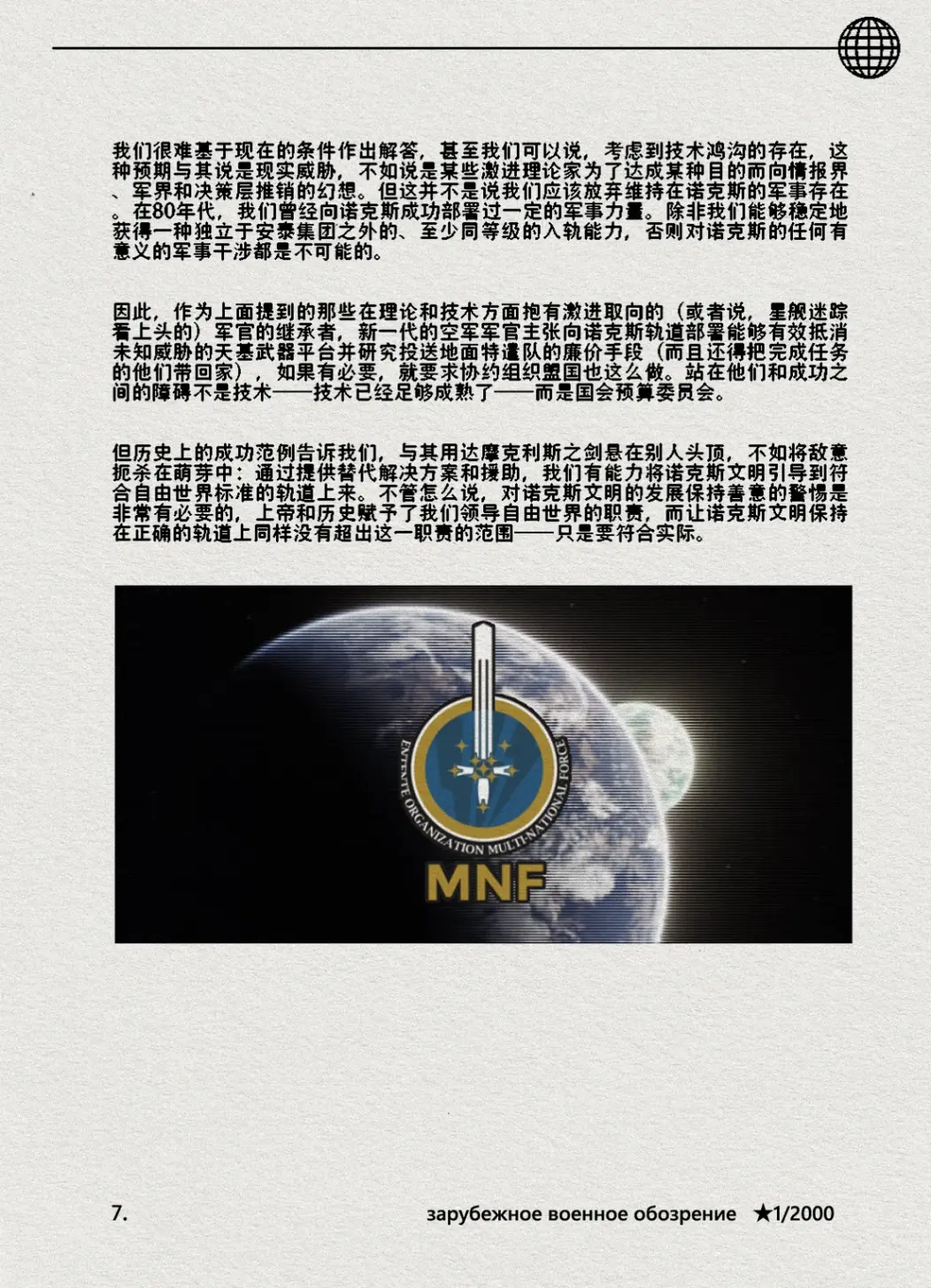
(Star Wars project image)
The Star Wars program ultimately did not become a reality. However, the technological advancements it amassed remain relevant today.

The "Universal Century" championed by totalitarianism has vanished, and the terrifying bombing from outer space has not materialized. However, all our actions today—from military operations to camping trips—are inseparable from the application of space technology. Although the development of Nox has stalled due to low economic returns, ignoring its importance from a national security perspective would be extremely unwise. While our outer space combat platforms were once significantly inferior to the Union in terms of quantity and technological level, currently, our space combat technology reserves and maturity are at least on par with the Phalanstery of yesteryear. However, is it necessary for us to replace the Union's former dominance in outer space, and if so, can the returns balance the investment?

("Polar" spacecraft image)
The "Polar" spacecraft is generally considered to be an experimental platform for some kind of space warfare complex.

Another question is whether the companion planet Nox should be considered in the assessment of non-traditional threats. Nox already possesses an industrialized armed force supported by the Union, whose technological level is comparable to many rogue states. What if the nation-states and various non-state actors currently on Nox acquire practically significant nuclear technology? What if they acquire some legacy technology from the Union and combine nuclear weapons with delivery systems?

It's difficult to provide an answer based on current conditions; in fact, we could argue that, given the technological gap, this expectation is less a real threat and more a fantasy promoted by certain radical theorists to the intelligence, military, and decision-making communities for specific purposes. However, this doesn't mean we should abandon our military presence in Nox. We successfully deployed a certain military force there in the 1980s. Any meaningful military intervention in Nox is impossible unless we can reliably acquire at least a similar level of orbital access capability independent of the Antey Group.

Therefore, as successors to those officers mentioned above who held radical theoretical and technological orientations (or, in other words, were obsessed with Starship), the new generation of Air Force officers advocated deploying space-based weapon platforms to Nox orbit capable of effectively countering unknown threats and researching inexpensive means of deploying ground task forces (and bringing them home afterward), and, if necessary, demanding that the Allied Allies do the same. The obstacle between them and success was not technology—the technology was mature enough—but the Congressional Budget Committee.

But historical examples tell us that it's better to nip hostility in the bud than to hang the sword of Damocles over someone's head: by providing alternative solutions and assistance, we have the ability to guide the Noxian civilizations onto a path that conforms to the standards of the free world. In any case, maintaining benevolent vigilance towards the development of the Noxian civilizations is essential. God and history have entrusted us with the responsibility of leading the free world, and keeping the Noxian civilizations on the right track is no more than fulfilling that responsibility—provided it is realistic.

Conclusion: Prepare for the next enemy

We can break down the above lengthy discussion into two opposing lists:

challenge:

*Technological advancements and shifts in the international security landscape may redefine the way wars are waged. Multinational forces possess greater political adaptability and acceptability in the new environment, thus enjoying greater freedom of action than during the Cold War. However, this freedom remains constrained by a series of limitations imposed by the current military-technological transition, which may affect the ultimate outcome of military operations.

*The burden of historical assets: The massive standing forces of the Union Powers built during the Cold War were intended for a full-scale nuclear war under nuclear conditions, and have now become a burden. Reforms based on disarmament and streamlining are imperative.

*The series of conflicts since 1990 have all ended in victory for multinational forces; however, these victories have not led Entent military and analytical communities to a unified understanding of future warfare models. New theories must be effectively integrated with technological advancements.

*The military environment within the Earth-Nox system has undergone significant changes in the post-space race era, making cost-benefit analysis the most crucial consideration. How can the agreement system maintain its absolute military superiority within the Earth-Nox system under these circumstances?

Possible solutions:

* Establish a comprehensive military operational theory that can guide military reforms under current and future (up to 2025) technological conditions. This theory must be scalable, robust, and operational, and can be understood and applied as a whole by all participants in the entire military system—military personnel and civilians, policymakers and strategists, businesses, and society.

* By allowing precision-guided weapons, entirely new platforms, and network-centric warfare concepts to take over the entire military machine, the next generation of multinational ground forces will maintain a technological gap of two generations (more than 20 years) with their main adversaries.

*While the methods of implementation are controversial, the new frontiers of future battlefields will not exclude the surface of the companion planet, as well as the interstellar space between Earth and the companion planet. Controlling this domain will help ensure that all potential conflicts are contained within the reach of the treaty system's forces.

*Weaponize the victories achieved by multinational forces from the late Cold War to the present, and effectively utilize this weapon on two levels: deterring potential adversaries and promoting armed forces reform in Wisconsin and its allies.

All these measures and recommendations are preparations for the United Vespuccian States next (or more) enemy before 2025. From this moment forward, the future development of the multinational force must be guided along a path that benefits the overall security of the free world, especially the long-term strategic security of Vespuccia. For the military itself, overly rapid changes in organization and equipment may only result in immature or unsuitable capabilities, but failing to adapt to change is equally futile. Our greatest challenge now is to progressively reform the organization, technology, and philosophy of our armed forces in a less risky manner, with the gentlest possible curve, before the emergence of the next enemy, so that the present does not destroy the future, nor does illusion lead to intellectual poverty, thus preparing us for centuries to come.