

Related pages : [Main page] [Encyclopedia]
ArmyTime, 15 December 1999
ArmyTime
15 December 1999       https://kedrgame.com/

STOP MOVEMENT
THE IMPACT ON ASSIGNMENTS, SCHOOLS AND MORE 8

New theories versus old habits: who will prevail?

Where should the multinational force go?

At the threshold of the new millennium, the Entente's military machine had reached a critical juncture of change. Admittedly, Colonel Hoffman was known within the military as a radical reformer; however, I must clearly state: he was too conservative.
- Lieutenant Colonel Roger Bremer, 101st Airborne Division, 1/187th Airborne Regiment

How to interpret victory? (BLACKHORSE)
"They're all small fry—small fry! The real Union forces wouldn't show such mercy!"

Security issues of binary Planetary systems:
We're on our feet, sir! 3

(United Vespuccian States)
Answer:
Advance at all costs 3
Where should the multinational force go?
Lieutenant Colonel Roger Bremer, 101st Airborne Division, 1/187th Airborne Regiment
Army Times, December 15, 1999

Earlier, "Army Times" and UVNI.org published Colonel Hayden R. Hoffman's article, "The Turning Point for Multinational Forces: New Technologies, New Frontiers, and a New Philosophy, and the Next Enemy." I pay tribute to Colonel Hoffman's 30 years of service and agree with his view that, on the threshold of the new millennium, the Entent military machine has reached a critical juncture of change. Admittedly, Colonel Hoffman is known within the military as a radical reformer; however, I must clearly state: he is too conservative. We must approach the blueprint for change in multinational forces with a cautious yet radical approach, avoiding a Sisyphean, futile process.

How to interpret victory?

I agree with Colonel Hoffman's assessment of the series of conflicts since the 1990s: the Gulf War was the last large-scale modern war, and I was fortunate enough to serve my country, leading the charge. In 1991, as a lieutenant fresh out of military academy, I participated in Operation Desert Storm with the 3rd Battalion, 187th Regiment, 101st Airborne Division. Within 12 hours, we not only penetrated over 120 kilometers into enemy territory but also established multiple logistical depots along the way, relying heavily on airdrops and air assault transport.
We crushed all resistance along the line: the enemy’s coalition mechanized forces neither responded effectively to our air assault nor were able to withstand our more conventional armored offensives on other fronts.

Nearly a decade later, I was still astonished to see the “Dark Horse Squadron,” once the fist of the Fifth Army, playing the role of a non-existent enemy day after day at the National Training Center. When I visited Fort Irwin in January 1997, veterans from all four combat squadrons were gathering to commemorate their old unit, many dissatisfied with the current state of affairs: some young officers and NCOs who had joined after the Cold War were doing everything they could to mimic the evil forces, even wearing Union Army uniforms (originals they had bought from former Union soldiers, not costumes) to work, using Union Army drill regulations for saluting, and the veterans wondering if they had crossed the Brandenburg Wall every time they entered the mess hall. I remember Lieutenant Norma Carlson of 1-13 ACR (better known within the army as “Natasha”) declaring after an exercise:

"They're all small fry—small fry! The real Union forces wouldn't show such mercy!"


(BMP-2 Pic)
The Dark Horse Squadron is responsible for "playing" the role of the Union BMP-2 infantry fighting vehicle.
Fort Irwin National Training Center, December 1997. Photo provided by the Fort Irwin Base Public Relations Center, Army.

(Natasha and BLACKHORSE pic)
The lieutenant had reason to be confident in her unit's "achievements," but throughout military history, armies have always been preparing for the previous war. All of the Dark Horse Squadron's victories came with extremely stringent conditions, vastly different from the real battlefield environments we faced in Mogadishu and Khafji. Many of the capabilities the adversary forces demonstrated on the exercise field are beyond the reach of Entent forces, and even we ourselves cannot achieve them in the near future. Rather than playing the villain in a video game, an elite mechanized force with the highest training and readiness levels in the entire army deserves to do far more valuable things!

Colonel Hoffman believed that a combined arms task force, capable of reaching globally within 72 hours and based on Entent cooperation, should be established to protect our interests. However, clinging to the legacy of the Cold War and being preoccupied with playing the enemy in the grave would not allow us to do this. The reality was that some within the military-industrial complex were not driving the development and procurement of military equipment out of national interest, but rather securing orders by systematically exaggerating the strength of allied forces and the technological level of their equipment—until the Gulf War.

We should understand the series of victories of the past decade as follows: the free world has achieved a victory over all systems except itself through undeniable strength and systemic superiority. This victory must be defended by a revolutionary, systemic reorganization of the free world's military forces—that is, the various members of the multinational forces. We must completely abandon the behavioral inertia inherited from the Cold War and recognize that our future adversaries will not be global rivals of equal caliber like the Union of Phalanstery. Only in this way can we effectively respond to new threats that will emerge in the future.

New theories versus old habits, who will win?

We must acknowledge one thing: wars of the past were far simpler—either everything was still, or one side attacked and both were destroyed. But things are different now: we can't use weapons called nuclear weapons to kill rats in a china shop. But what would the rats do if they got their hands on that weapon? —————— They would launch it at us without hesitation. The only solution to ensuring that our potential enemies, those rogue states or non-state actors, never take any action that would cause substantial harm to the people of the free world, lies not in how we destroy their armies, but in whether we can convince them that they cannot win.

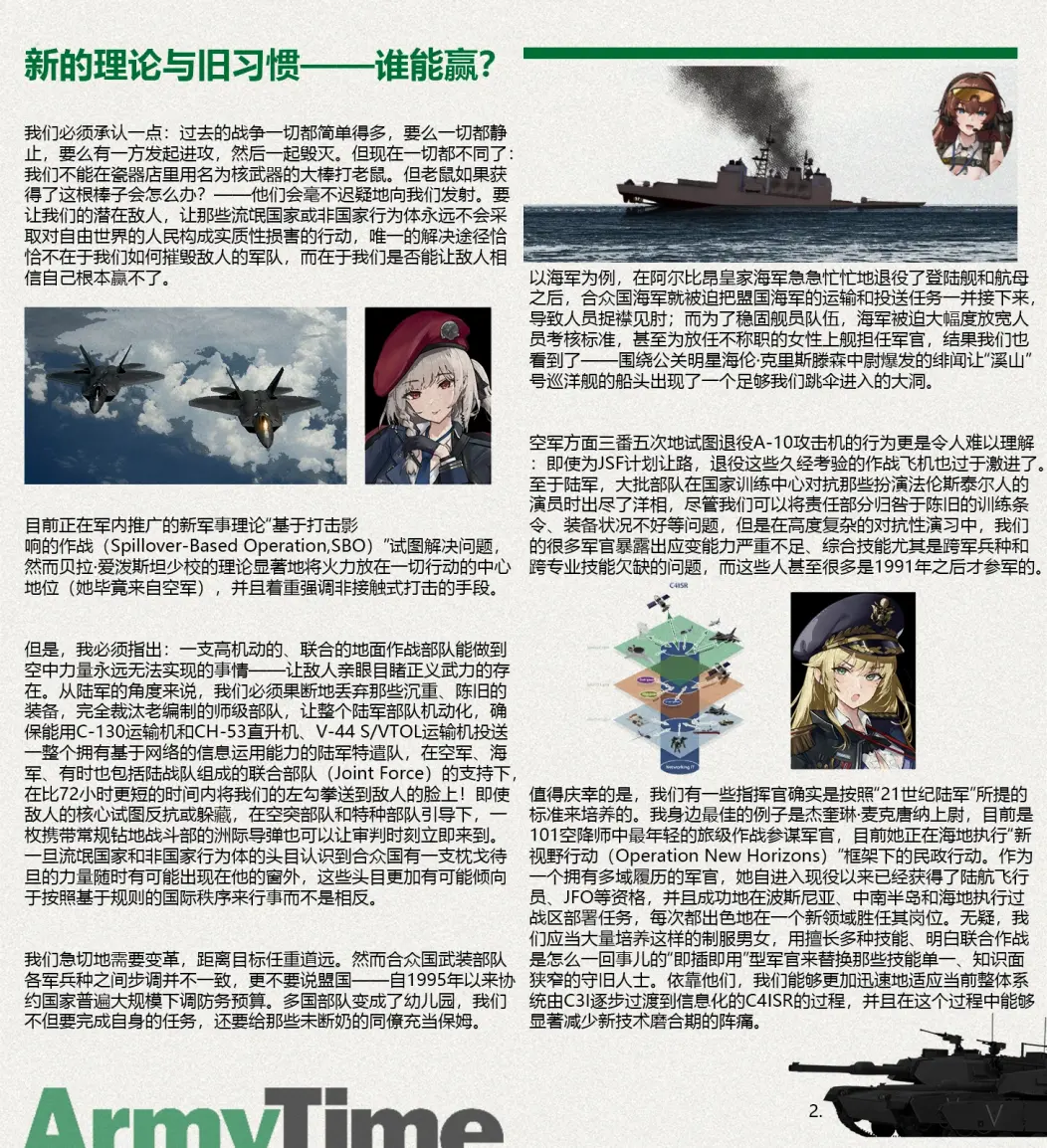
(Fighter jet + bella pic)
The new military theory currently being promoted within the military, "Spillover-Based Operation"
Spillover-Based Operation (SBO) "attempted to solve the problem; however, Major Bella Epstein's theory significantly placed firepower at the center of all operations (after all, she came from the Air Force) and emphasized non-contact strike methods."

However, I must point out that a highly mobile, joint ground force can do what air power can never achieve—deliver a glimpse of the existence of just force to the enemy. From the Army's perspective, we must decisively discard heavy, outdated equipment, completely eliminate old-fashioned divisional units, and mobilize the entire Army force. This will ensure that we can deploy an entire Army task force with network-based information capabilities, supported by a joint force comprised of the Air Force, Navy, and sometimes Marine Corps, in less than 72 hours! Even if the enemy's core attempts to resist or hide, an ICBM carrying a conventional bunker-buster warhead, guided by air assault and special forces, can bring immediate judgment. Once the leaders of rogue states and non-state actors realize that the United Vespuccian States possesses a ready-made force that could appear at any moment outside their window, they are more likely to act in accordance with the rules-based international order than the other way around.

We desperately need change, and we are far from our goal. However, the various branches of the United Vespuccian States Armed Forces are not moving in unison, not to mention the Allied powers—since 1995, the Entente countries have generally reduced their defense budgets on a massive scale. The multinational force has become a kindergarten; we not only have to complete our own missions, but also act as babysitters for our still-developing colleagues.


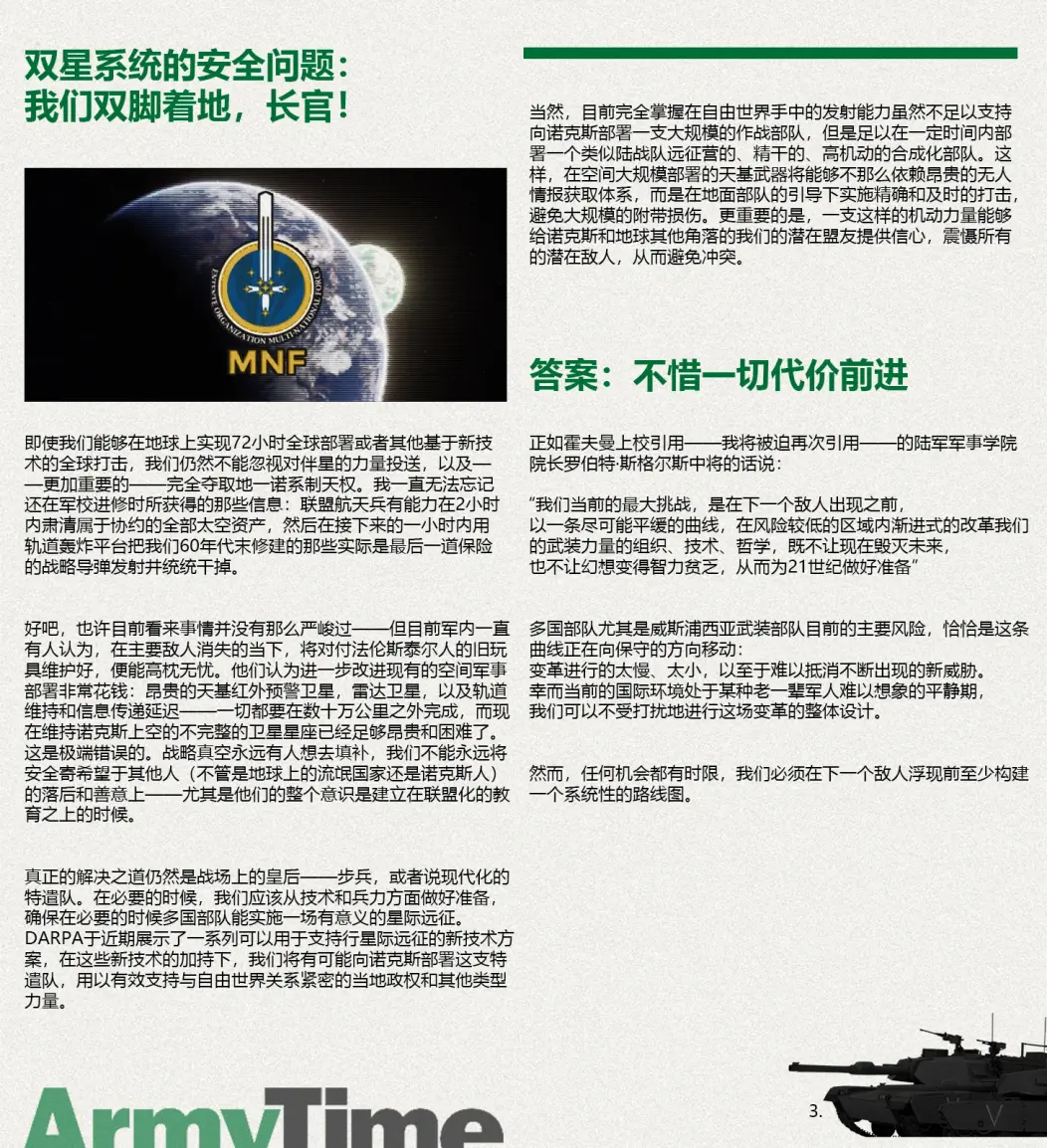
(Boat pic)
The fact is this: the Gulf War became the last large-scale war, maintaining the traditional multinational force size and the prospect of tens of thousands of various nuclear warheads, whether for the Vespuccian Armed Forces or other allied forces under the Supreme Allied Command Europe, became both a waste of public funds and ineffective. One question lingered in the minds of all soldiers: why have we been winning? Countless wrecks of Union weapons and equipment burned on battlefields around the world, leading many to believe that the Phalanstery was a complete shell, a sensationalist advertisement concocted by arms dealers. This view is not entirely wrong; after all, we now clearly understand that the Union suffers from serious deficiencies in both its military equipment and its military structure.

The Air Force's repeated attempts to retire the A-10 attack aircraft are even more incomprehensible: even if it's to make way for the JSF program, retiring these tried-and-tested combat aircraft is too radical. As for the Army, large numbers of troops made a fool of themselves when they faced off against actors playing the role of Phalanstery at the National Training Center. While we can partly attribute the blame to outdated training regulations and poor equipment, in highly complex adversarial exercises, many of our officers revealed serious deficiencies in adaptability and comprehensive skills, especially in cross-service and cross-professional skills. Many of these officers had even joined the military after 1991.

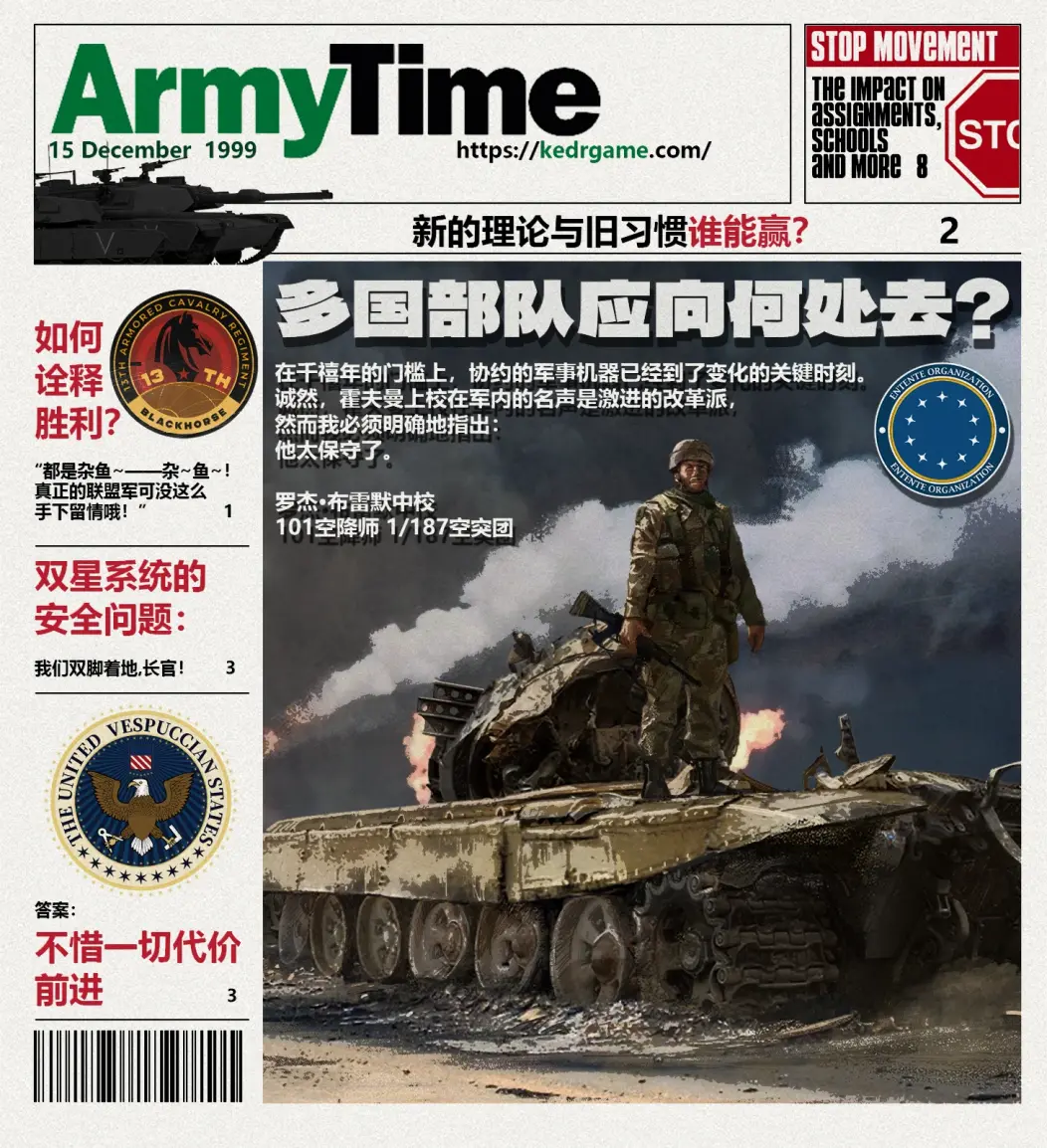
(military Diagrame + Jaceline pic)
Fortunately, some of our commanders are indeed trained according to the standards of a "21st-century army." A prime example is Captain Jacqueline McDonald, currently the youngest brigade-level operations staff officer in the 101st Airborne Division, currently conducting civilian operations in Haiti under Operation New Horizons. As an officer with multi-domain experience, she has obtained qualifications such as Army Aviation Pilot and JFO since entering active duty, and has successfully performed theater deployments in Bosnia, Indochina, and Haiti, consistently excelling in her new role. Undoubtedly, we should cultivate a large number of such uniformed men and women, replacing those with limited skills and narrow knowledge with "plug-and-play" officers who are proficient in multiple skills and understand joint operations. Relying on them, we can more quickly adapt to the current overall system's gradual transition from C31 to information-based C4ISR, and significantly reduce the growing pains of adapting to new technologies.

Security concerns with the binary Planetary system: We're on our feet, sir!

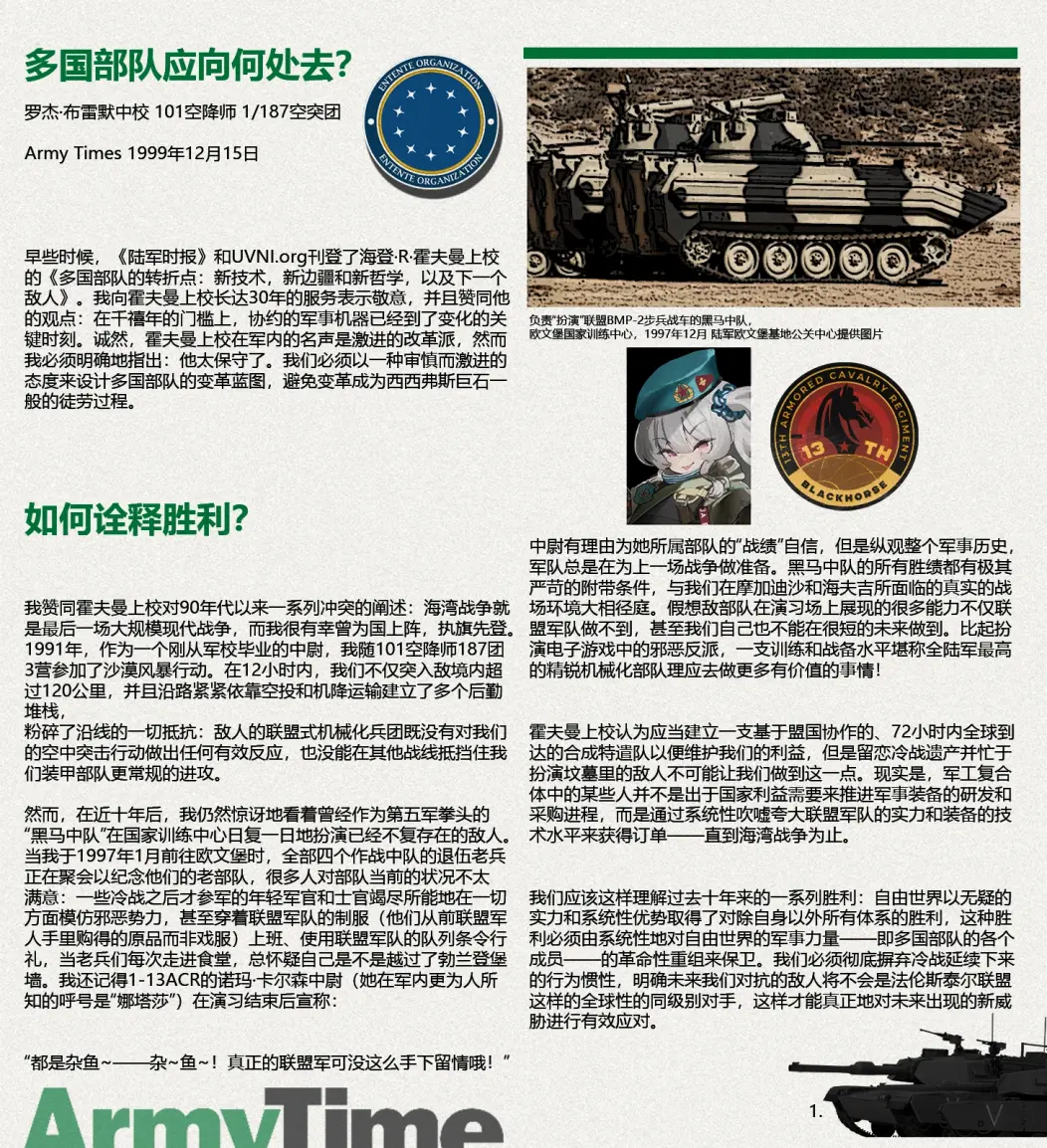
(MNF pic)

Even if we can achieve 72-hour global deployment or other new technology-based global strikes on Earth, we still cannot ignore the power projection onto our companion Planet, and—more importantly—the complete takeover of the Earth-Nox space system. I can never forget the information I received while studying at military academy: the Union Space Force had the capability to wipe out all contractual space assets within two hours, and then, within the next hour, launch and destroy all the strategic missiles—which were essentially our last line of defense—using orbital bombardment platforms.

Okay, perhaps things haven't seemed so dire yet—but there's a persistent belief within the military that, with the main enemy gone, maintaining the old toys used against Nox will ensure peace of mind. They argue that further improvements to existing space military deployments are extremely expensive: costly space-based infrared early warning satellites, radar satellites, and the associated orbit maintenance and information transmission delays—all of which must be conducted hundreds of thousands of kilometers away, and maintaining an incomplete satellite constellation over Nox is already expensive and difficult enough. This is utterly wrong. Strategic vacuums will always be filled, and we cannot forever rely on the backwardness and goodwill of others (whether rogue states on Earth or Nox)—especially when their entire consciousness is built on Union-based education.

The real solution remains the queen of the battlefield—the infantry, or rather, modernized task forces. When necessary, we should prepare, both technologically and in terms of manpower, to ensure that a multinational force can conduct a meaningful interplanetary expedition. DARPA recently showcased a series of new technological solutions that could support interplanetary expeditions. With the support of these technologies, we may be able to deploy this task force to Nox to effectively support local regimes and other forces closely connected to the free world.


Of course, while the launch capabilities currently entirely in the hands of the free world are insufficient to support the deployment of a large-scale combat force to Nox, they are sufficient for the deployment of a lean, highly mobile combined arms force, similar to a Marine Expeditionary Battalion, for a certain period. This would allow space-based weapons deployed on a large scale in space to be less reliant on expensive unmanned intelligence gathering systems, and instead conduct precise and timely strikes guided by ground forces, avoiding large-scale collateral damage. More importantly, such a mobile force could provide confidence to Nox and our potential allies in other parts of the world, deterring all potential adversaries and thus preventing conflict.

Answer: Advance at all costs.

As Colonel Hoffman quoted—and I will be forced to quote again—Lieutenant General Robert Stigles, the superintendent of the Army War College:

"Our greatest challenge at present is to gradually reform the organization, technology, and philosophy of our armed forces in a less risky area, along the gentlest possible curve, before the next enemy emerges, so as not to let the present destroy the future, nor let illusions impoverish our intellect, thus preparing us for the 21st century."

The main risk for multinational forces, especially the Armed Forces of Vespuccia, is precisely that this curve is shifting in a conservative direction: change is proceeding too slowly and too gradually to offset emerging new threats. Fortunately, the current international environment is in a period of relative calm that older generations of military personnel could hardly have imagined, allowing us to design this overall transformation undisturbed.

However, every opportunity has its time limit, and we must at least build a systematic roadmap before the next enemy emerges.