

Related pages : [Main page] [Encyclopedia]
The Columbia Post, April 12, 1999
The Columbia Post

(1) After the dreams of the space race were shattered, a bubble called "The Joint Developement Region" Still held on : another side of Nox's life.
(2) Columbia Post Newsletter        (3)April 12, 1999        (4)Karen Grossman

(5) The photo on the right was taken in Unity City in 1999 by freelance photojournalist Eddie Cohen. (6)
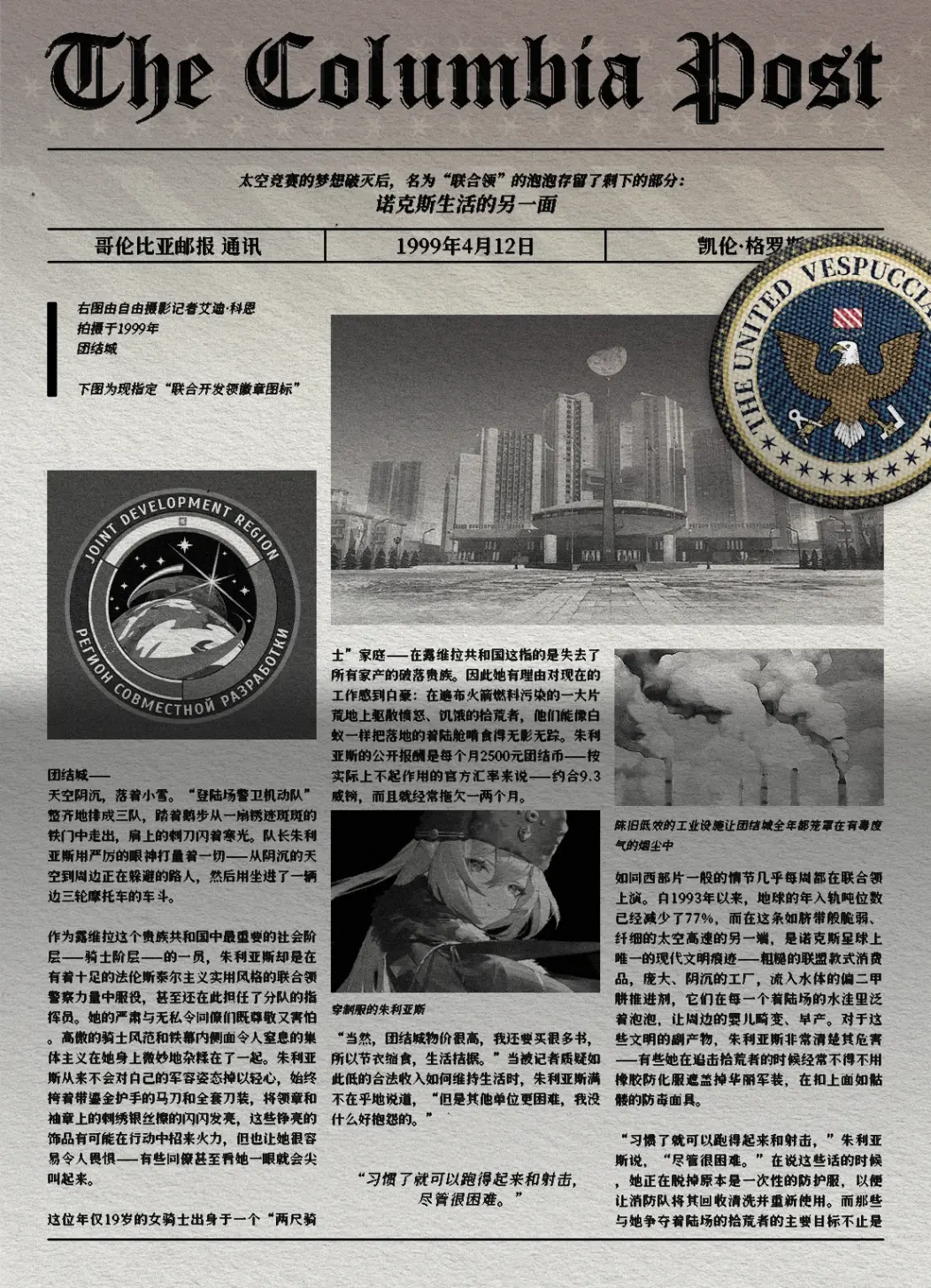
The image below shows the currently designated "Joint Development Region " insignia . (7)

Unity City:
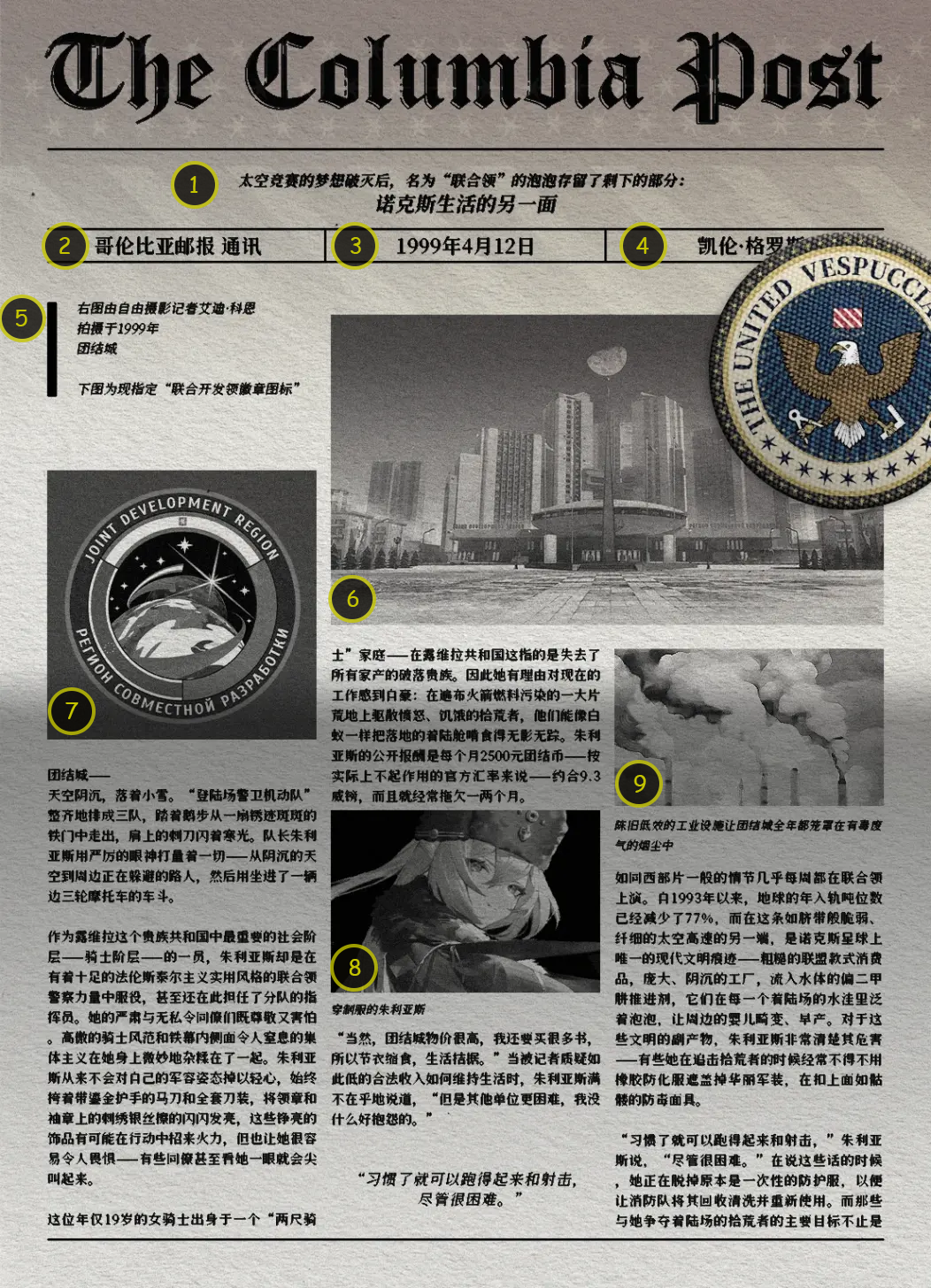
The sky was overcast, and light snow was falling. The "Cosmodrome Tactical Unit" marched out in three neat rows from a rusty iron gate, their bayonets gleaming coldly on their shoulders. Captain Julius surveyed everything with a stern gaze—from the overcast sky to the passersby who were taking cover nearby before getting into the back of a sidecar motorcycle.

As a member of the most important social class in the noble republic of Ruvila, the knightly class Julius served in the United Territory police force, which was characterized by a thoroughly Phalansterian pragmatism, Julius held the position of squad leader. Her seriousness and selflessness earned her both respect and fear from her colleagues. A subtle blend of haughty chivalry and the suffocating collectivism within the Iron Curtain clung to her. Julius never neglected her military bearing, always carrying a saber with a gilded hilt and a full set of daggers, polishing the embroidered silver threads on her collar and sleeve insignia until they gleamed. These gleaming ornaments might attract fire during operations, but they also made her easily intimidating—some colleagues would even scream at the mere sight of her.

This 19-year-old female knight came from a "two-foot-tall" family.

"two-foot-tall" families—in the Republic of Ruvila refers to impoverished noble families who have lost all their possessions. Therefore, she had reason to be resentful of her current job: driving away angry, hungry scavengers across a vast wasteland littered with rocket fuel contamination, scavengers could devour landed pods like termites. Julius's official pay was 2,500 union ruble per month—equivalent to about 9.3 Vespuccian pounds at the practically nonexistent official exchange rate—and it was often delayed by a month or two.

(8)
Julius in uniform

“Of course, prices are high in Unity City, and I also need to buy a lot of books, so I have to cut back on my food and clothing and live frugally.” When questioned by a reporter about how he could make a living with such a low legal income, Julius said nonchalantly, “But other units are in even more difficulty, so I have nothing to complain about.”

"Once you get used to it, you can run and shoot, even though it's very difficult."

(9)
Outdated and inefficient industrial facilities leave Unity City shrouded in toxic fumes and dust year-round.

A Western-like scenario plays out almost weekly in the Union. Since 1993, Earth's annual tonnage into orbit has decreased by 77%, and at the other end of this fragile, slender space highway lies the only trace of modern civilization on Nox crude Union-style consumer goods, massive, gloomy factories, and unsymmetrical dimethylhydrazine propellant flowing into waterways, bubbling in puddles at every landing site, causing deformities and premature births in the surrounding infants. Julius is acutely aware of the dangers of these byproducts of civilization—sometimes she has to cover her ornate military uniform with a rubber hazmat suit and fasten a skull-like gas mask while chasing scavengers.

“Once you get used to it, you can run and shoot,” Julius said, “though it’s difficult.” As she spoke, she was removing her disposable hazmat suit so the fire department could collect, clean, and reuse it. And the scavengers vying for the landing site had more than just that…
The Columbia Post

The landing capsule's cargo: Scavengers would dismantle any valuable parts from the landing capsule itself to trade or repair their own old equipment. Most of the time, the Cosmodrome Tactical Unit didn't interfere with the scavengers who recycled scrap equipment. However, the battle for the junk and cargo intensified; in Julius's words, "one piece of junk had three groups eyeing it." The Cosmodrome Tactical Unit, with only a hundred or so personnel, had to mobilize its entire force on every landing recovery day. Even so, a considerable amount of important cargo launched from Earth was still stolen and ended up on the black market.

(1) The garbage dumps on the outskirts of Unity City were also a place where impoverished Noxian people "panned for gold."

(2) involuntary time capsule
-Editor Clutterbuck

Every morning in Unity City, hurried crowds fill the streets shrouded in a bluish mist. This mist comes from pollutants emitted by the United Central Petrochemical Complex and the "Spark" Joint Nitrogenation Plant, both employing nearly ten thousand workers. Standing among the commuters and observing the street scene, anyone would feel that the Union still seems to exist in this small corner of civilization: the dull streets are devoid of neon lights and commercial advertisements, the roadside is covered with mimeographed posters, and people place their lunchboxes in the steam cabinets of the factory canteens, carrying hemp rope net bags to queue for food. In the kindergartens and schools attached to the factories and government agencies, mixed-race children chase and play wildly, making "cannonballs" in mud puddles to bombard the windows of teachers they dislike. It is a time capsule.

Forty-nine years after Sputnik 1 ignited a space frenzy, 1.2 million Earthlings a significant decrease from the 1990 figure—and 700,000 Noxian holding "Union Territory Internal Passports" resided in the United Territory. All of them were either forced or voluntarily dependent on the United Territory Under a bureaucratic system, they lived off the salaries of "public enterprises".

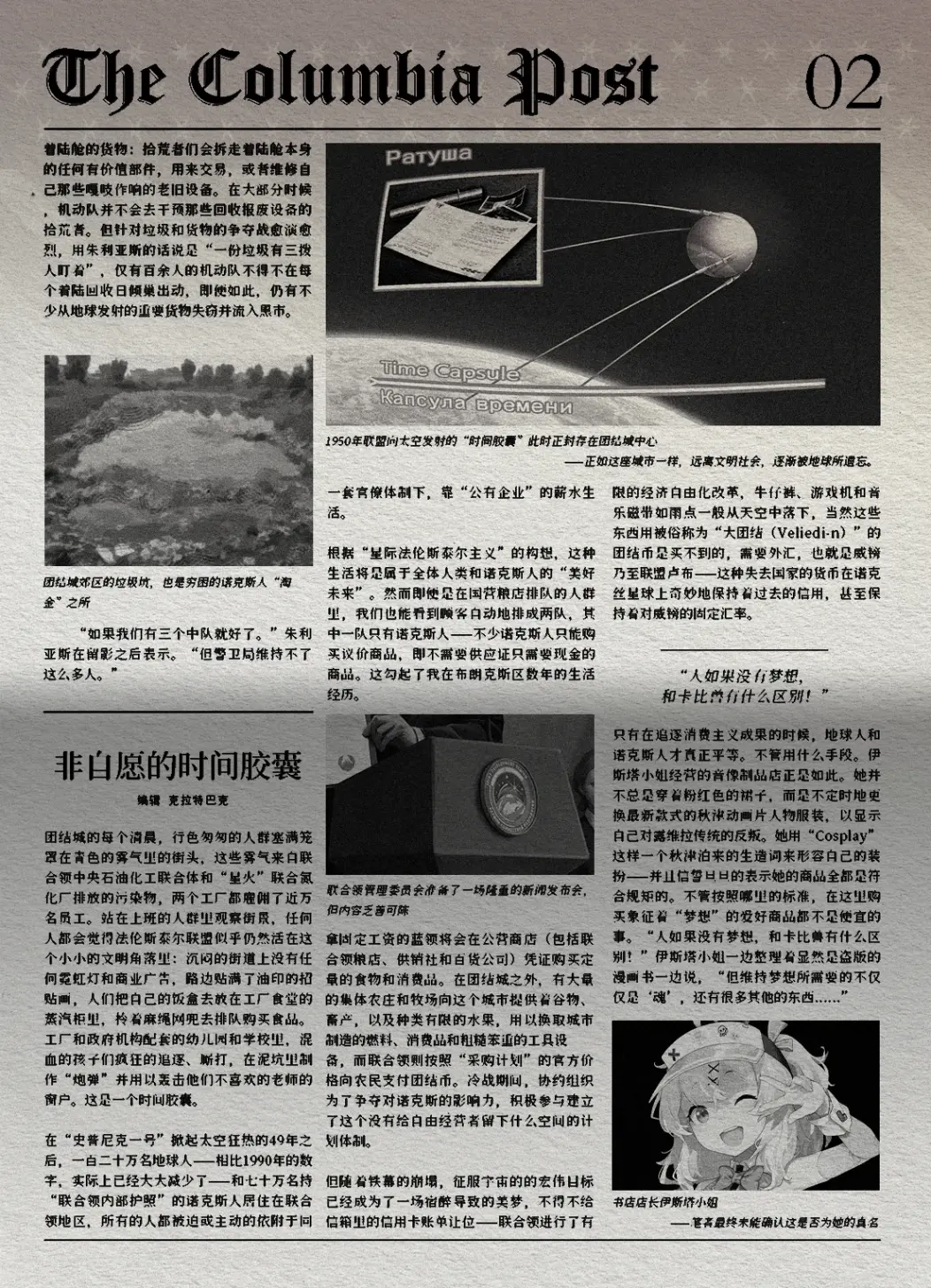
(3) The time capsule launched into space by the Allied Powers in 1950 is now sealed in the center of Unity City
- just like this city, the Time capsule is far removed from civilized society and gradually getting forgotten by the earth.

According to the concept of "Interstellar Phalanstism," this kind of life would be a "bright future" for all humanity and the Noxian people. However, even in the queues at state-run grocery stores, we could see customers automatically forming two lines, one of which consisted only of Nox people—many of whom could only buy negotiated goods, that is, goods that required cash but not ration coupons. This reminded me of my years living in the Bronx.

(4)The Joint Leadership Management Committee prepared a grand press conference to launch the new policy, but the content was lackluster.

Blue-collar workers on fixed wages would purchase a fixed amount of food and consumer goods with vouchers at public stores (including joint grain stores, supply and marketing cooperatives, and department stores). Outside Unity City, numerous collective farms and ranches supplied the city with grain, livestock, and a limited variety of fruit in exchange for fuel, consumer goods, and crude, cumbersome tools manufactured by the city.
The Allied powers, in their struggle for influence over Nox, actively participated in establishing this planned system that left little room for independent operators. Meanwhile, the Allied leaders paid farmers in Unity Rubles according to the official prices outlined in the "procurement plan."

But with the collapse of the Iron Curtain, the grand ambition of conquering the universe has become a hangover-induced dream, forced to give way to the credit card bills in the mailbox, the United Territory has undertaken a series of economic liberalization reforms, jeans, game consoles, and music tapes rain down from the sky. Of course, these things couldn't be bought with the Unity Rubles which was commonly known as "great unity (Veliedi-n)." They required foreign exchange, namely the Vespuccian Pounds or even the Unity Rubles. This currency, which had lost its country, miraculously maintained its past credit on the planet Nox, and even maintained a fixed exchange rate against the Vespuccian pounds.

(5) "What's the difference between a person without dreams and Kirby?"

Only when pursuing the fruits of consumerism do Earthlings and Noxian truly achieve equality, regardless of the means employed. This is precisely the case with Miss Ishtar's video store. She doesn't always wear pink dresses, but rather changes into the latest Akitsu anime character costumes from time to time to show her rebellion against Ruvilian's traditions. She uses the Akitsu-derived neologism "cosplay" to describe her attire—and swears that all her merchandise is compliant with regulations. By any standard, buying hobby items symbolizing "dreams" here is not cheap. "What's the difference between a person without dreams and Snorlax!" Miss Ishtar says, sorting through obviously pirated comic books. "But maintaining dreams requires more than just a 'soul,' there are many other things..."

(6) Miss Ishtar, the bookstore manager
—The author was ultimately unable to confirm whether this was her real name.

The Columbia Post

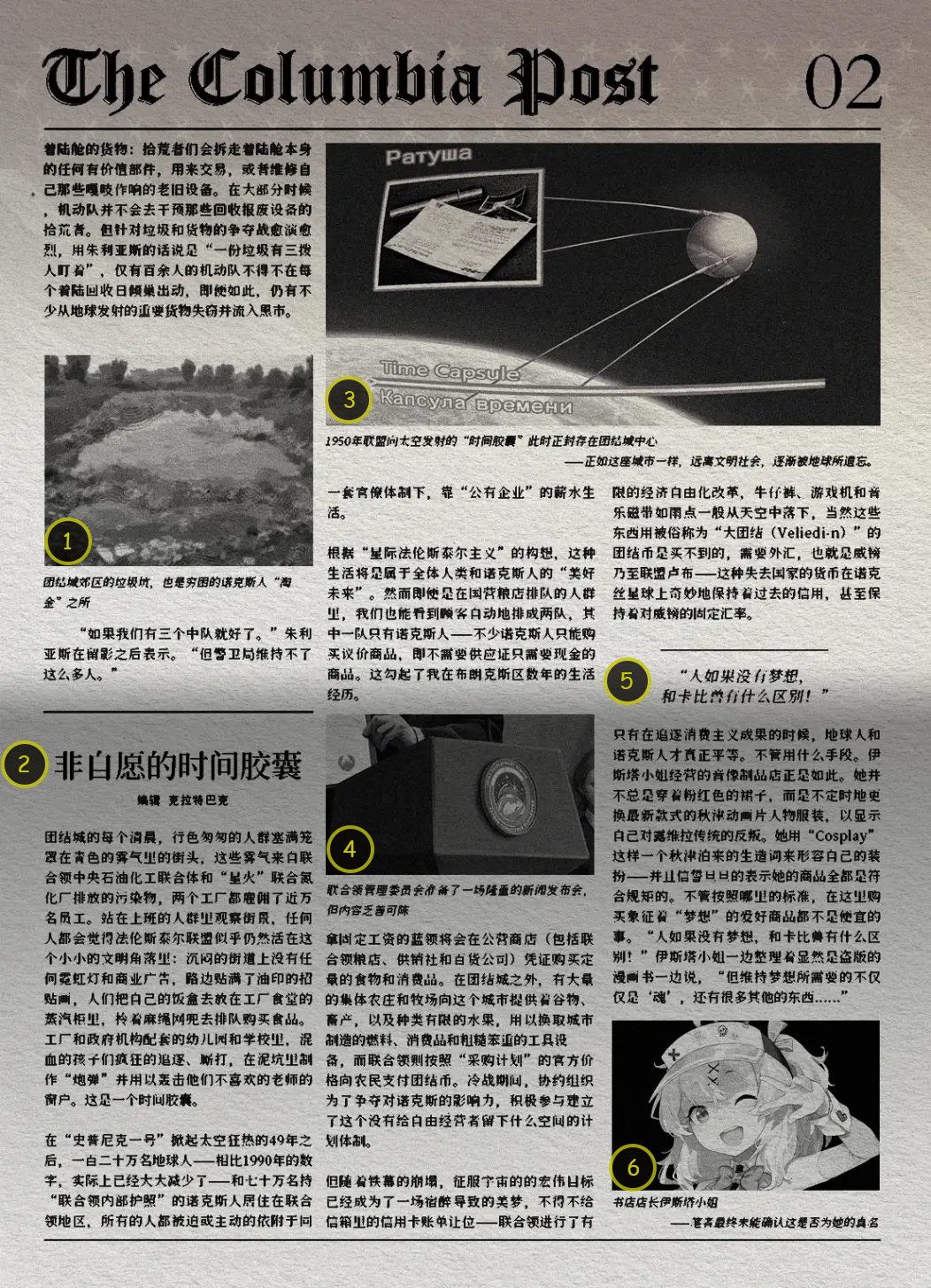
(1) One of Malek's collections: the "Opening Up a New World" medals, which he had many of but were not valuable.

"What will he do?" I asked Keji. Keji shrugged.

"He'll be fine, at most he'll lose a few dozen pounds... It's not the first time. I heard Marek is helping that thief 'Firefly' sell stolen goods. 'Firefly' steals important items everywhere—mostly from bad pepole,The midlle age man has a large family to support. "

Mr. Mark lifted his coat to show us his collection of badges, indicating he had many more to his name. By the time we emerged from the nearby shantytown, Mr. Mark had already made nearly 1,000 Vespuccian Pounds in business. Our van was crammed with all sorts of odds and ends, from Kingdom souvenirs to Allied Army medals. I spotted a surprisingly exquisite otter fur coat, priced at only 430 Vespuccian Pounds. Mr. Mark looked at the undamaged cassette tape in my hand with excitement and astonishment; this was probably his first time handling genuine audio-visual products.

In the end, I followed local custom and traded a cassette tape of "Willie and the Poor Boy" by the Shimizu Revival Band for the coat with 400 pounds in cash. But as we were leaving, officers from the security detail burst into his hut. We watched in horror as the weary-looking officers in their worn-out uniforms handcuffed Mr. Marek and put him in the police car, ignoring us completely.

“The security bureau actually has time to cause him trouble… Let’s go,” Ibrahim Af said.

"I got it from someone, and then I'll find a way to exchange it for money and goods to help the poor." Mr. Ibrahim grinned, lit a cigarette, and said, "This coat you got was previously worn by a merchant from the Republic; I'm 100% sure of it. After all, we can't starve to death; we have to find another way."

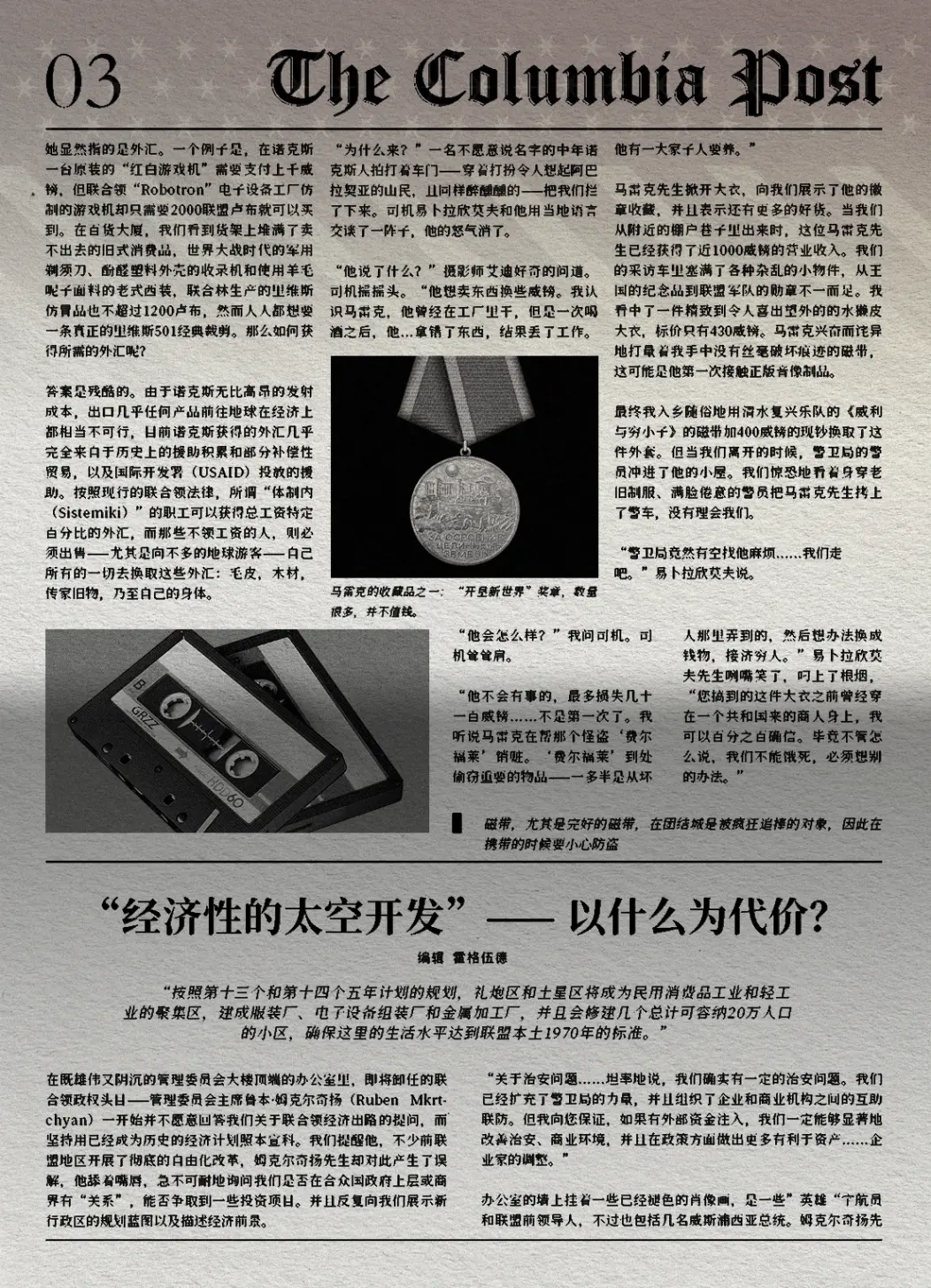
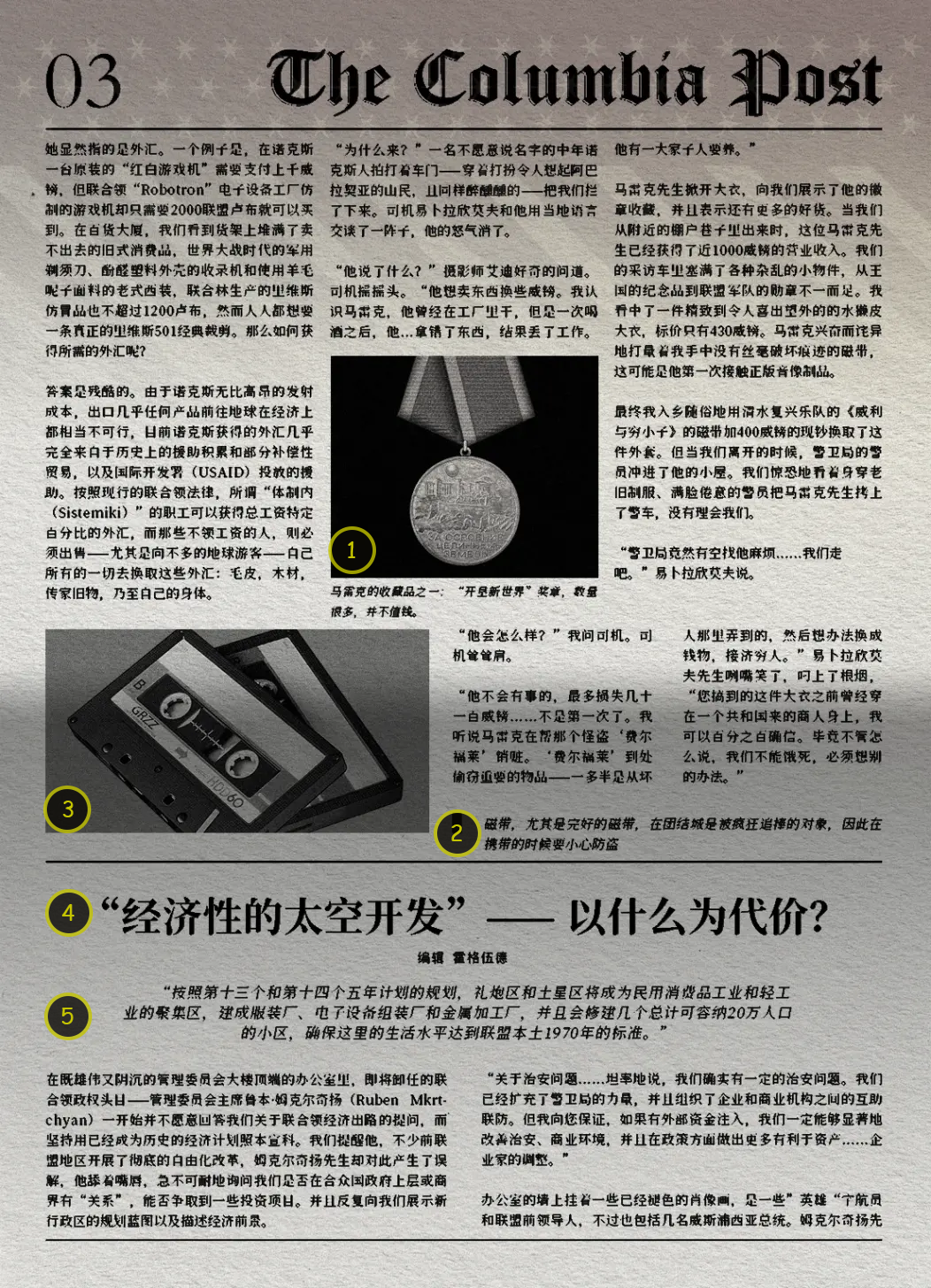
(3)<(2)cassette tapes, especially intact ones, are wildly sought-after in Unity City, so be careful to prevent theft when carrying them.

(4) "Economical space development" — at what cost?
Editor Hogwood

(5) "According to the plans of the 13th and 14th Five-Year Plans, the Salute District and Saturn District will become clusters of civilian consumer goods industries and light industries, with the construction of garment factories, electronic equipment assembly plants and metal processing plants. Several communities will be built to accommodate a total of 200,000 people, ensuring that the standard of living here reaches the level of the Union homeland in 1970."

In his office atop the imposing yet somber Management Committee building, the outgoing Chairman of the Management Committee, Ruben Mkelchiyan, was initially reluctant to answer our questions about the economic future of the Union, insisting on reciting outdated economic plans. We reminded him that many former Union territories had undergone thorough liberalization reforms, but Mr. Mkelchiyan seemed to misunderstand this. He licked his lips and impatiently inquired whether we had "connections" in the upper echelons of the United Vespuccian States government or in the business world, and whether we could secure some investment projects. He repeatedly showed us the blueprints for the new administrative district and described its economic prospects.

"Regarding security... Frankly, we do have some security issues. We have expanded the security bureau and organized mutual defense among businesses and commercial entities. But I assure you, with the injection of external funding, we will be able to significantly improve security, the business environment, and make policy adjustments that are most favorable to asset...entrepreneurs."

The office walls are adorned with faded portraits of "heroic" union astronauts and former leaders of the Union, but also several Vespuccian presidents. Mkelchiyan

The Columbia Post

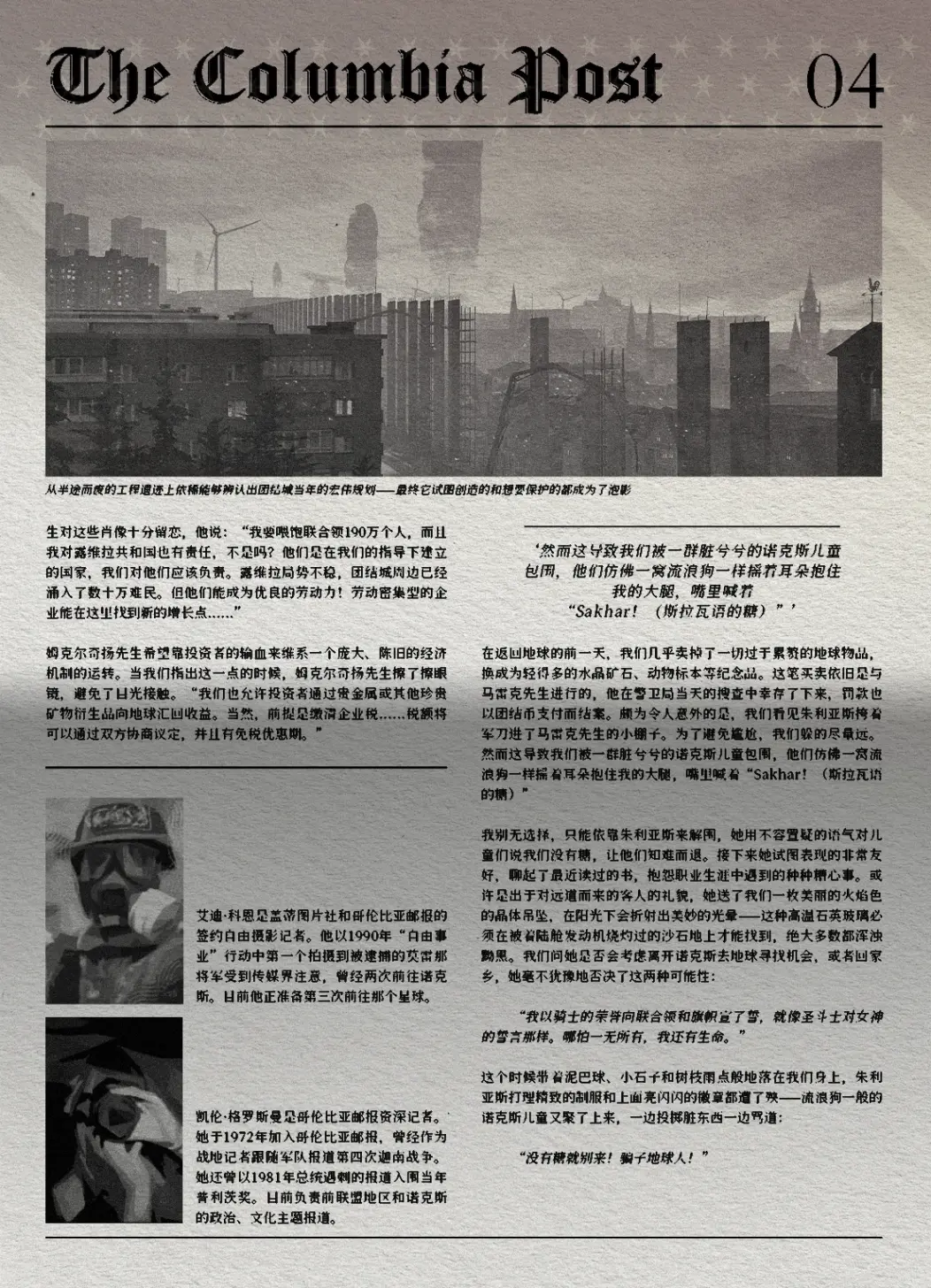
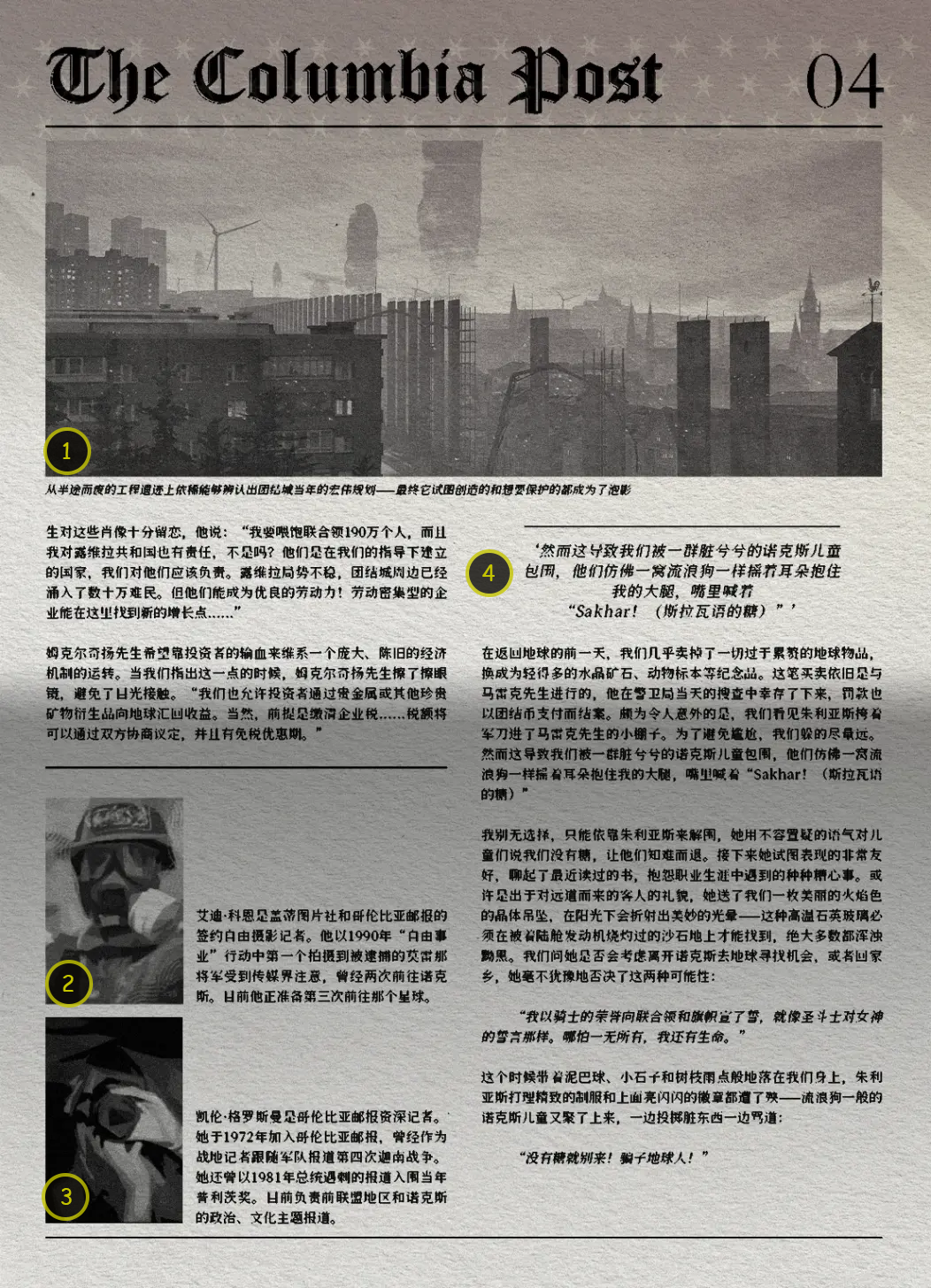
(1) From the unfinished remains of the project, one can still vaguely discern the grand plans that Unity City once had—ultimately, what it tried to create and what it wanted to protect both became nothing but a mirage.

The man was very fond of these portraits, saying, "I have to feed the 1.9 million people of the United territories, and I also have a responsibility to the Republic of Ruvila, don't I? They were built under our guidance, and we are responsible for them. The situation in Ruvila is unstable, and hundreds of thousands of refugees have poured into the area around Unity City. But they can become a valuable workforce! Labor-intensive businesses can find new growth opportunities here..."

Mr. Mkrtchyan hopes to keep a large, outdated economic system running thanks to investor infusions. When we pointed this out, Mr. Mkrtchyan rubbed his eyes to avoid the sunlight. “We also allow investors to repatriate profits to the earth through precious metals or other valuable mineral derivatives. Of course, this is contingent on paying corporate taxes…the amount of tax will be negotiated between the two parties, and there will be a tax-free period.”


(2) Eddie Cohen is a freelance photojournalist contracted with Getty Images and the Columbia Post. He gained media attention for being the first to photograph the arrested General Arena during Operation Freelance in 1990 and has traveled to Nox twice. He is currently preparing for his third trip to the planet.

(3) Karen Grossman is a senior reporter for the Columbia Post. She joined the Columbia Post in 1972 and served as a war correspondent covering the Fourth Canaan War. She was also shortlisted for the Pulitzer Prize for her coverage of the 1981 presidential assassination. Currently, she is responsible for political and cultural reporting in the former Union region and Nox.


(4) "However, this led to us being swarmed by a bunch of dirty Nox kids who clung to my legs like a litter of stray dogs, wagging their ears and shouting 'Sakhar!' (Slava for sugar)."

The day before returning to Earth, we sold almost all our cumbersome Earthly possessions, exchanging them for much lighter souvenirs such as crystals and taxidermy specimens. This sale was again done with Mr. Malek, who had survived the police raid that day and whose fine was settled in Unity rubles. Quite unexpectedly, we saw Julius, carrying a military knife, enter Mr. Malek's shed. To avoid embarrassment, we kept our distance. However, this resulted in us being surrounded by a group of dirty Nox children who clung to my legs like a pack of stray dogs, wagging their ears and shouting "Sakhar!" (Slava for sugar).

I had no choice but to rely on Julius to get me out of the predicament. She told the children in an unequivocal tone that we had no candy, discouraging them from trying. She then tried to be very friendly, talking about books she had recently read and complaining about the various frustrations of her career. Perhaps out of politeness to guests who had come from afar, she gave us a beautiful flame-colored crystal pendant that refracted a beautiful halo in the sunlight—this high-temperature quartz glass could only be found on sandy ground scorched by the landing module's engines, and most of it was cloudy and black. We asked her if she would consider leaving Nox to seek opportunities on Earth, or returning home, and she unhesitatingly rejected both possibilities:

"I swore an oath to the Union and its banner with the honor of a knight, just as a Saint Seiya swore an oath to Athena. Even if I lose everything, I still have life."

At this moment, mud balls, pebbles, and twigs rained down on us, and Julius's neatly made uniform and shiny badges were all ruined—the Nox children, like stray dogs, gathered around again, throwing filth and cursing:

"Don't come if you don't Have candy! You're a lying Earthling!"