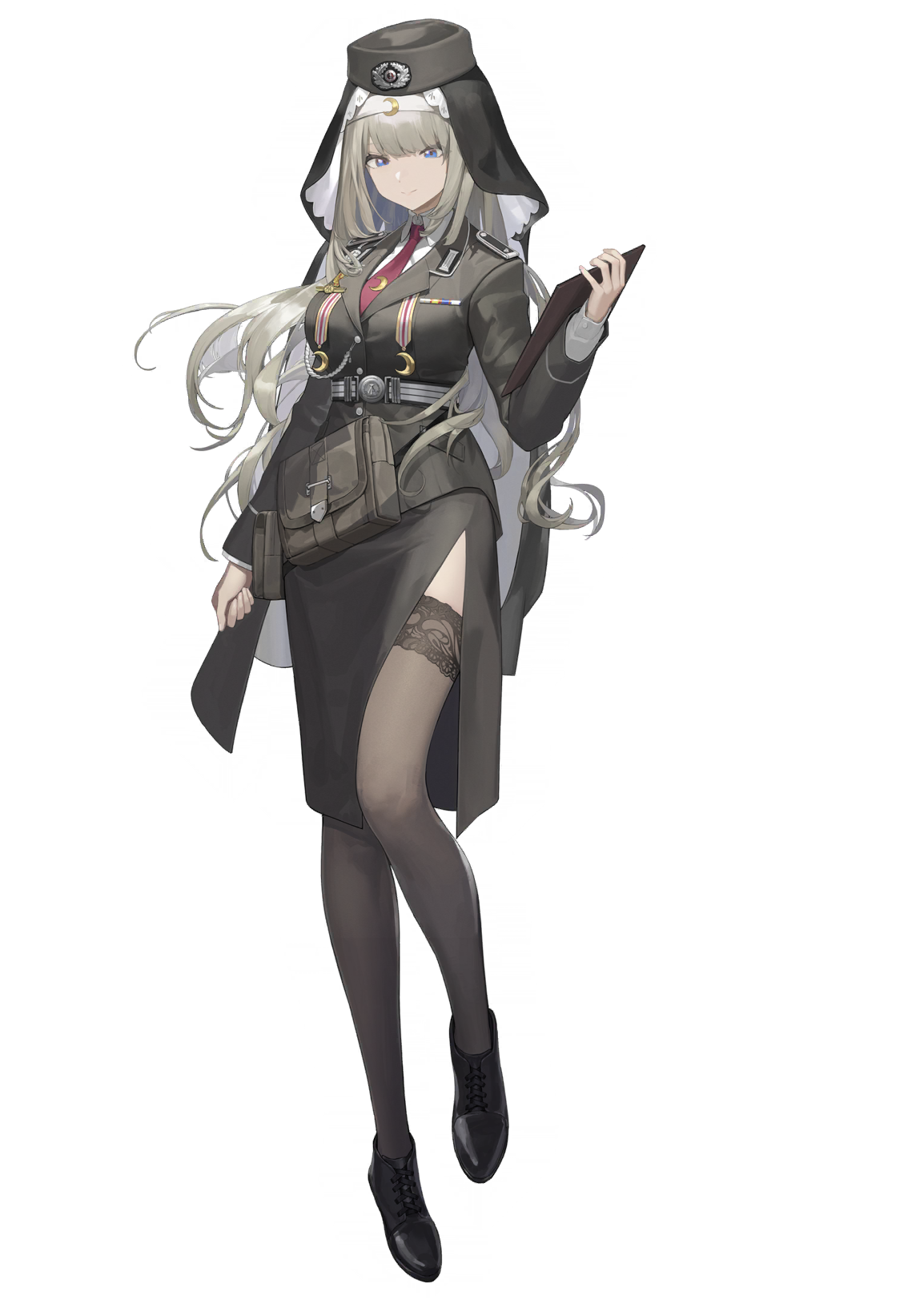
Personal History
A member of the 501st Long-Range Reconnaissance Group and a Staff Sergeant in the 4th Motorized Infantry Division's long-range reconnaissance company. She is of mixed Nox heritage. Her father was an intellectual from Ostheim who participated in the construction of the JDR; after working there for ten years, he returned to Earth with his wife and daughter. She holds a degree in mathematics from the Technical University of Dresden. Within the reconnaissance group, she serves as the radio operator and is also deeply committed to looking after the daily well-being of her comrades-in-arms.
Sylvia comes from a large, sprawling family; among her forebears were pioneers of the Phalanstery movement active even before the World War, and many of her relatives currently reside within Schmalkalden. One of her great-uncles was a fighter who met a tragic end in a militarist prison; the reconnaissance battalion she serves in today bears his pen name as its honorary title. Unlike most Ostheim citizens, Sylvia enjoys relatively free access to visit relatives in Schmalkalden. This allowed her to realize early on the vast disparity in economic development and living standards between the two nations. She is constantly torn between loyalty to her family's beliefs and her homeland, and the prosperity and advancement of the Entente nations—a conflict that leaves her wavering between allegiance and doubt.
Her access to publicly available technical data from both Eastern and Western nations has given her an exceptional aptitude for understanding sophisticated military electronics. Meanwhile, television broadcasts and popular magazines from Schmalkalden introduced her to styles of decoration and cuisine far removed from the monotonous standards of military barracks life. Erika loves to tease Sylvia about this "decadent lifestyle," yet she never seems to question Sylvia's loyalty because of it.
Erika’s trust in Sylvia is entirely well-founded, even if she remains unaware of the underlying reason: Sylvia is secretly an informant for the MfV, held under duress due to compromising information. Her wavering ideological leanings had been detected by security services as far back as her university days. MfV showed considerable leniency toward Sylvia, given her privileged background; past transgressions would be overlooked as long as she helped monitor her companions' thoughts and reported on them.
As the clouds of war gathered, arguments between Sylvia and Erika became increasingly frequent. The crux of their dispute was whether the people of the Entente nations truly loved peace and would actually stop their governments from waging war. Sylvia would often try to explain that the people of Schmalkalden, who enjoyed a life of comfort—had no desire for conflict. Yet, mid-explanation, she would suddenly recall her role as an informant. She would hesitate, wondering if convincing Erika might inadvertently create an obligation to report her, thereby landing her friend in trouble—perhaps it was better to simply keep quiet? ...Of course, more seasoned intelligence officers would find Sylvia’s inner conflict and hesitation laughable; their concerns revolved around the threat of nuclear war and urgent military intelligence, making the act of snitching seem utterly trivial by comparison.
| Sylvia | ★★★★★ |
| [ BASIC FILE ] | |
| Codename | Veilchen (ФАЙЛЬХЕН) |
| Rank | Staff Sergeant |
| Race | Ruvilian |
| Occupation | Military Personnel |
| EGO Strength | Strong |
| Nationality | Republic of Ruvila |
| Class | Scout |
| Affiliation | 501th long range reconnaissance team |
| [ BASIC ATTRIBUTES ] | |||
| Health | 540 | Defense | 280 |
| Movement Speed | 2.7 | Armor Value | 1620 |
| Moral Value | 1200 | Mobile Shooting | Yes |
| Hit Projection | 1.72 | ||
| [ GUN ATTRIBUTES ] | |||
|
|
|||
| Weapon Type | Asault Rifle [MPi-KMS] | ||
| Damage | 87 | Ammo Capacity | 30 |
| Attack Range | 3 | Proficiency | 35% |
| Morale Damage | 12 | Armor Penetration | 12 |
| Critical Hit Rate | 8% | Reload Time | 3.2s |
| Fire Rate | 9 | ||
| Damage Reduction | 85/74/68 | ||
| [BASE] | [AFFECTION SKIN] |