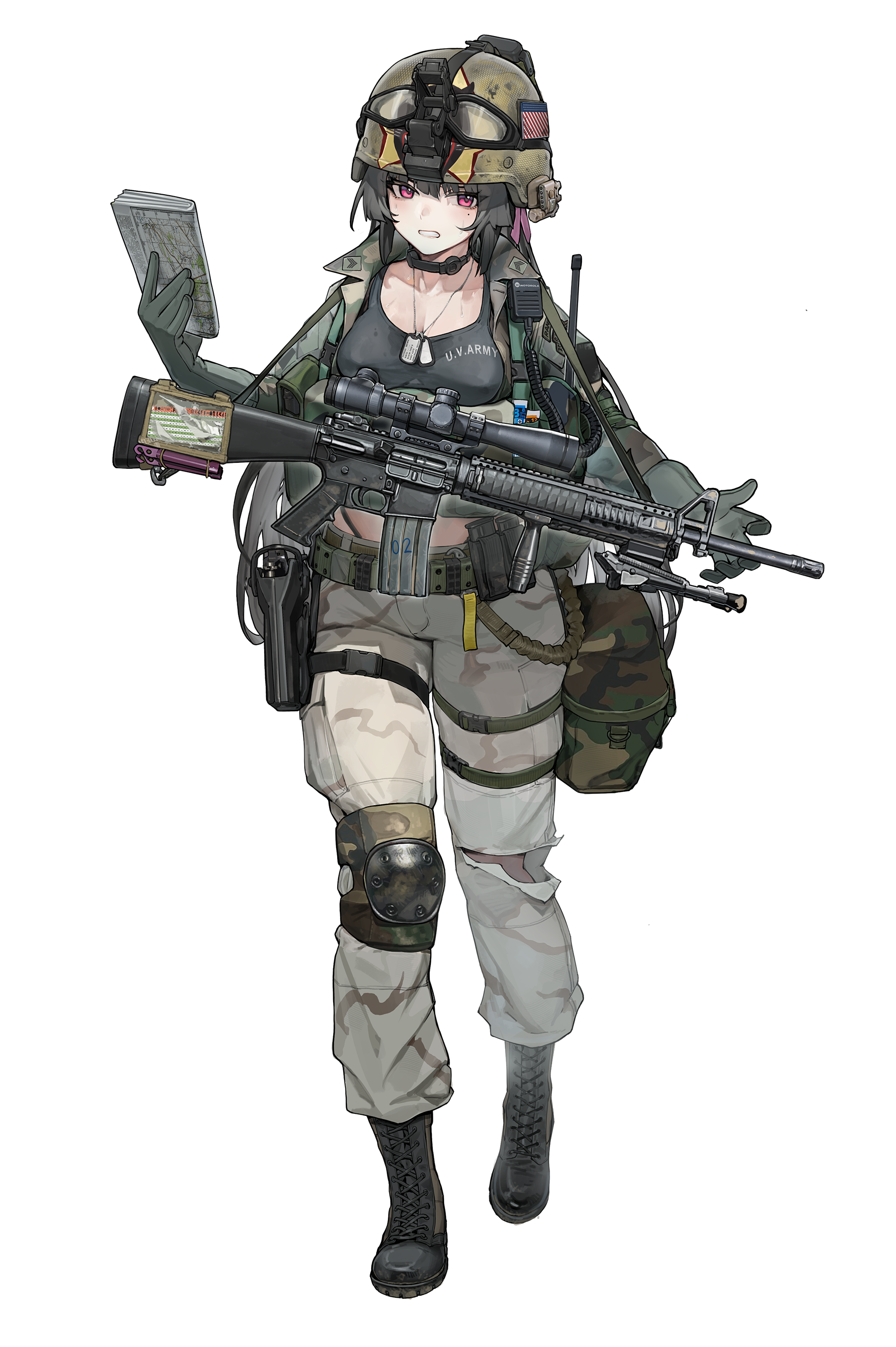
Personal History
The indigenous people of Zarab envisioned Vespuccia based on their own experiences: a federation of dozens of states, each ruled by princes and nobles. The most compelling evidence for this perception was the presence of a "princess", Captain Qingfang, among the multinational forces stationed there.
As a civil affairs officer, Qingfang was viewed by the locals as the authority figure of the multinational force; she was responsible for mediating disputes between soldiers and civilians and handling compensation claims in accordance with local customary law. Although Qingfang never acknowledged having noble status, she appeared refined, composed, and dignified compared to the other, rougher Vespuccian soldiers. She greeted everyone by pressing her palms together and bowing her head, often uttering strange phrases that sounded like ancient aphorisms, details that only reinforced the rumors of her aristocratic lineage. On one occasion, a local soldier, believing an Earth instructor had insulted his family, took the instructor hostage in a fit of rage; he refused to back down until the "Noble Lady" herself apologized on behalf of the multinational force.
Of course, the United Vespuccian State had no king, and she was not truly a princess. Yet, given the circumstances and the need to complete her mission, Qingfang had no choice but to maintain the persona. Over time, the strain inevitably took a toll on her mental well-being.
As a police officer and military veteran, Qingfang’s adoptive father often taught her that few things in the world are absolutely good or bad; conflicts usually stem from differing perspectives, cultures, or momentary impulses. Crude intervention based on subjective judgment could actually be dangerous. To survive street patrols, one had to remain calm and learn to listen. Qingfang did not have a naturally mild temperament, yet the habit of restraining her emotions and maintaining rationality stayed with her.
Consequently, she developed a little trick: transforming immediate stress into anticipation for the future, effectively "tricking" herself into moving forward. For instance, when she faced trouble at school as a child, the thought that she could enjoy the leftover doughnuts her father brought home from patrol, provided she stayed out of trouble, would shift her mood to one of eager anticipation for the treat. In truth, she didn't even have a sweet tooth, but devouring the doughnuts always filled her with a profound sense of satisfaction, a reward for having persevered and made it through the day. This habit persists to this day: whenever she feels she can't go on, she heads straight to the base commissary, buys a whole box of doughnuts, and devours them just as she did in childhood, restoring her composure and confidence in the process.
In April 1975, three-month-old Nguyen Thi Thanh Phuong was placed by her father onto a UH-1 helicopter bound for the USS *Santa Cruz* off the coast of Saigon; she never saw her biological parents again. She was adopted by a comrade-in-arms of her father, a fellow paratrooper, and the family eventually settled on the West Coast of Vespusia. Money was tight; her adoptive father worked as a police officer and her adoptive mother in a restaurant, all while raising two biological children of their own.
During elementary school, Phuong was photographed with her adoptive parents, who were dressed in traditional theatrical costumes. Upon seeing her in such flamboyant, gaudy attire, classmates began whispering that she was an exiled "Princess of the Nguyen Dynasty." With every transition to a new school, the "princess" legend followed her, and many boys, hoping to marry royalty, even confessed their feelings to her. To fit in, Phuong instinctively played along, embodying the "Nguyen Princess" persona her classmates imagined; she used the "reserve befitting a princess" to keep others at a distance and conceal her family's financial struggles. Unable to afford university tuition, she enrolled in the ROTC, though she never aspired to be a commander. When she learned that the 96th Civil Affairs Battalion was expanding, prioritizing recruits of Southeast Asian descent, she submitted her application.
In Qingfang's mind, civil affairs work consisted of mundane tasks involving civilians, putting up flyers, screening movies, handing out candy. It was the sort of "sideline" duty that young officers hungry for combat glory shunned, yet it was perfectly suited to her patient nature. She also heard that, with the UN taking over the chaotic Khmer region, the 96th Civil Affairs Battalion might be selecting her for a deployment there to assist with reconstruction and relief efforts. Across the border lay the homeland she had been separated from for over twenty years; she hoped this assignment might offer a chance to discover the fate of her biological parents. However, she had not anticipated two things: First, Civil Affairs units were not the gentle outfits she had imagined; they were required to operate deep behind enemy lines to rally the local populace, necessitating rigorous training in airborne operations and special warfare. Qingfang nearly drowned during a river-crossing exercise in the Columbia River, but driven by the stubborn resolve that "I chose this path, so I must see it through," she ultimately completed the training. Second, she did not return to Southeast Asia as expected; the Civil Affairs battalion decided to form a small detachment, numbering just over a dozen personnel, to join Army Special Forces and others in "Operation Whirlwind" in the Zarab mountains. Thanks to her outstanding performance during training, Qingfang was personally selected to join the team deploying to Nox.
Upon disembarking from the transport, Qingfang immediately lost all optimism about the future. In theory, Civil Affairs operations were designed to bolster local support for the multinational force. In reality, however, their local ally Mazdak was headstrong and obstinate, while multinational troops treated the region like the "Wild West," acting with reckless abandon. Qingfang found herself overwhelmed, constantly shuttling by helicopter to mediate disputes and handle compensation claims. Amidst this chaos, the old rumor about her being a "Princess of the Nguyen Dynasty", one she had long managed to shake off, began to circulate once again...
| Qingfang | ★★★★ |
| [ BASIC FILE ] | |
| Codename | Tonny ("ТОННЫ") |
| Race | Earthling |
| Occupation | Military Personnel |
| EGO Strength | None |
| Nationality | United Vespuccian States |
| Class | Sniper |
| Affiliation | 75th Commando Brigade |
| [ BASIC ATTRIBUTES ] | |||
| Health | [missing] | Defense | [missing] |
| Movement Speed | [missing] | Armor Value | [missing] |
| Moral Value | [missing] | Mobile Shooting | [missing] |
| Hit Projection | [missing] | ||
| [ GUN ATTRIBUTES ] | |||
|
|
|||
| Weapon Type | Sniper Rifle [SAM-R] | ||
| Damage | [missing] | Ammo Capacity | 10 |
| Attack Range | 6 | Proficiency | [missing]% |
| Morale Damage | [missing] | Armor Penetration | [missing] |
| Critical Hit Rate | [missing]% | Reload Time | [missing]s |
| Fire Rate | [missing] | ||
| Damage Reduction | 95/93/91/88/85/82 | ||
| [BASE] | [AFFECTION SKIN] |