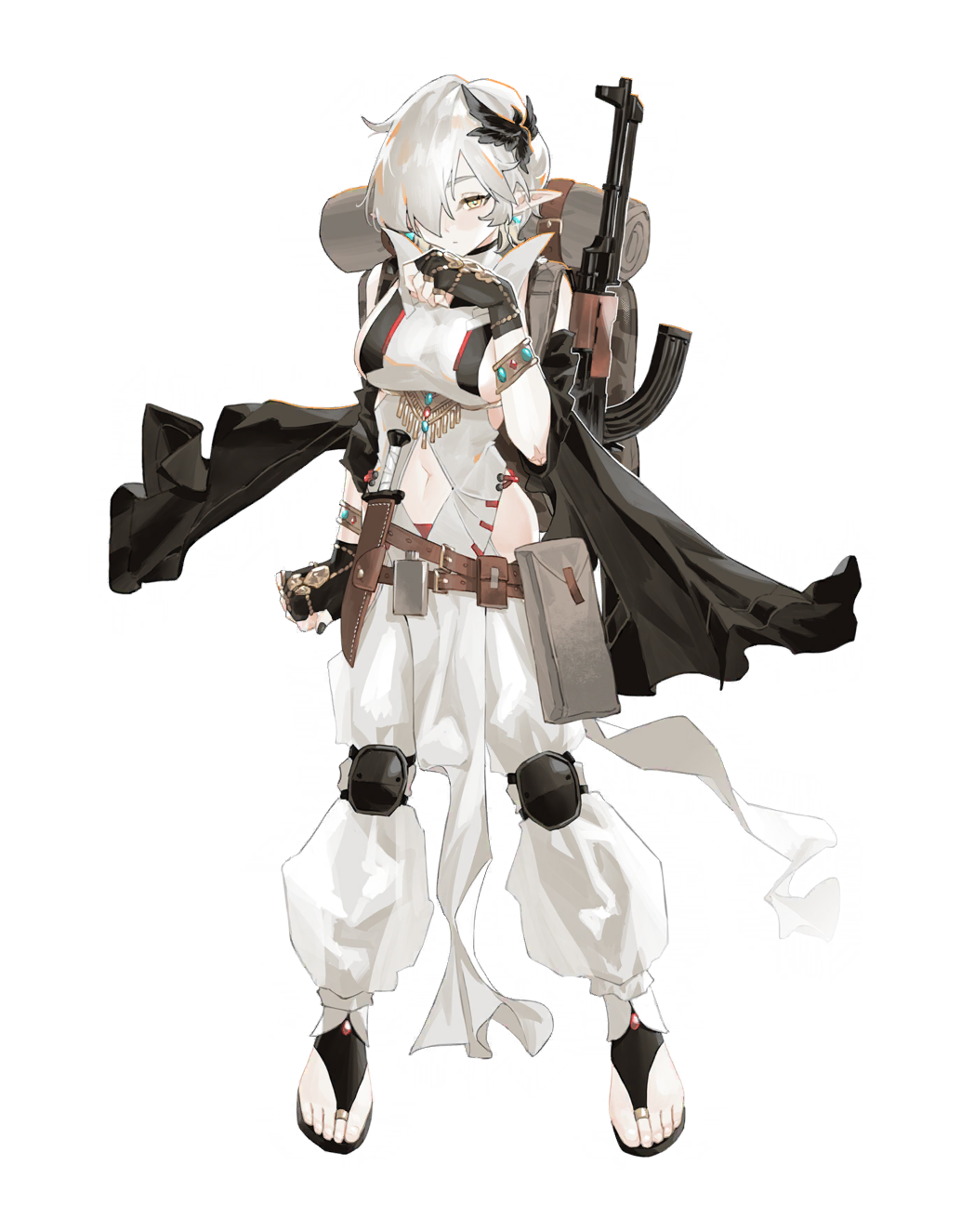
Personal History
In the wanted notices issued by Mazdak, the dancer Nanuli is branded a major criminal who corrupts public morals and the only high-ranking fugitive from the Zarab Democratic Republic; consequently, she is to be killed on sight. To certain warlords and tribes, however, she is a carrier of a dreaded "affliction of the limbs" that one avoids at all costs. While her attacks pose little physical danger, they are deeply humiliating: warriors often lose control of their bodies during skirmishes, involuntarily breaking into coy, mincing dance moves, leaving them the laughingstock of their peers and utterly disgraced. A terrifying rumor also circulates that any child who witnesses her performance will, in the dead of night, involuntarily mimic her movements; they then slip out of their homes in a trance-like dance, never to be seen again.
Nanuli herself bears some responsibility for the rise of these chilling tales. She is unfailingly kind and patient, and her elegant dancing is a delight to behold; she performs even without pay, offering a rare source of entertainment amidst the ceaseless warfare of Zarab. Yet, those drawn by her beauty and grace soon retreat in alarm. Regardless of age, gender, or physique, she insists on coaxing everyone she meets to learn the profound "Dance of Radiance", a cherished piece of "intangible cultural heritage" she seeks to pass on.
Nanuli repeatedly assures people that, with the aid of her EGO, learning the dance is effortless. One need only relax and sense the resonance with the World Spirit, or simply surrender control of one's body to her EGO. Then, anyone can match her moves: leaping, stomping, and spinning like a whirlwind on a tiny patch of carpet to the rhythm of frenzied drums, or gliding gracefully through a hall with captivating poise. The sight of fluttering sleeves and shimmering tassels dazzles the onlookers, while the dancers themselves become intoxicated by the spinning and leaping, achieving a state of sublime harmony with the World Spirit. However, the primary reason the public was reluctant to learn the dance was not a fear of the trouble involved; rather, it was the perception that the dance's overly graceful movements were unsuited for men, the exhaustion caused by the struggle to make a living, the fear of violating Mazdak’s prohibitions, or simply a lack of understanding regarding the term "Intangible Cultural Heritage."
The "Dance of Radiance" inherited by Nanuli was believed to foster harmony between the individual and the World Spirit, possessing the power to enhance one's EGO. Yet, like all refined arts of the Circassian people, this dance had been on the verge of extinction before the arrival of the Earthlings. Just as Nanuli was painstakingly seeking ways to preserve the art form, the "Zarab Democratic Republic", a state backed by the Union, extended a helping hand. Originally, the Dance of Radiance was a solo performance executed on a small, round rug to the accompaniment of simple instruments; with the assistance of dance experts from the Union, Nanuli developed new choreography featuring mobile footwork and ensemble routines performed by groups, all accompanied by a full band. The Democratic Republic also pledged to establish a dance school for her and promised an ideal society based on equality, a concept Nanuli interpreted as a world where everyone had the opportunity to dance joyfully.
Nanuli would occasionally admit candidly that only female dancers could achieve a seamless union with the World Spirit through the steps she taught, whereas men lacking EGO abilities could merely enjoy the physical exhilaration of the movement. She recalled that a male version of the Dance of Radiance had once existed, one designed to complement the female version, and while those steps might have resonated more deeply with the male psyche, they had unfortunately been lost to history.
Among the many students who, whether willingly or under duress, received instruction from Nanuli, there was one notable figure: the warlord Mazdak himself. During his time as a bathhouse attendant, he had worked diligently to learn the dance from Nanuli in order to please his customers. The Circassians are a forgetful people, and Nanuli, who taught without discrimination, had not retained a particularly strong impression of the youth then known as Atachifilai; yet Mazdak could not be certain that she had truly forgotten this former star pupil of hers. As long as this bearer of intangible cultural heritage remained alive, Mazdak would never be free from the fear that his dark past might be exposed.
| Nanuli | ★★★★★ |
| [ BASIC FILE ] | |
| Codename | LUNCH (РУЧАКА) |
| Race | Circassian |
| Occupation | Dancer |
| EGO Strength | Weak |
| Nationality | Zarab |
| Class | Heavy Weapon Specilaist |
| Affiliation | Zarab Militia |
| [ BASIC ATTRIBUTES ] | |||
| Health | 720 | Defense | 280 |
| Movement Speed | 2.2 | Armor Value | 1080 |
| Moral Value | 1200 | Mobile Shooting | No |
| Hit Projection | [missing] | ||
| [ GUN ATTRIBUTES ] | |||
|
|
|||
| Weapon Type | Machinegun[RPK] | ||
| Damage | 90 | Ammo Capacity | 70 |
| Attack Range | 4 | Proficiency | [missing]% |
| Morale Damage | [missing] | Armor Penetration | [missing] |
| Critical Hit Rate | [missing]% | Reload Time | [missing]s |
| Fire Rate | [missing] | ||
| Damage Reduction | 85/72/64/52 | ||
| [BASE] | [AFFECTION SKIN] |